
When you have coordination challenges, turn to Runsheng Transformer for help
It's all about making things easy, building partnerships, and providing a point of contact.
A step up transformer is a static electrical device that raises the voltage of an alternating current supply from the primary winding to the secondary winding. The relationship is simple and predictable: Vp/Vs = Np/Ns. When the secondary winding has more turns than the primary, output voltage is higher while current drops in proportion. That single principle is the reason high-voltage transmission exists at all — lower current means lower I²R losses, smaller conductor cross-sections and far more efficient long-distance power delivery.
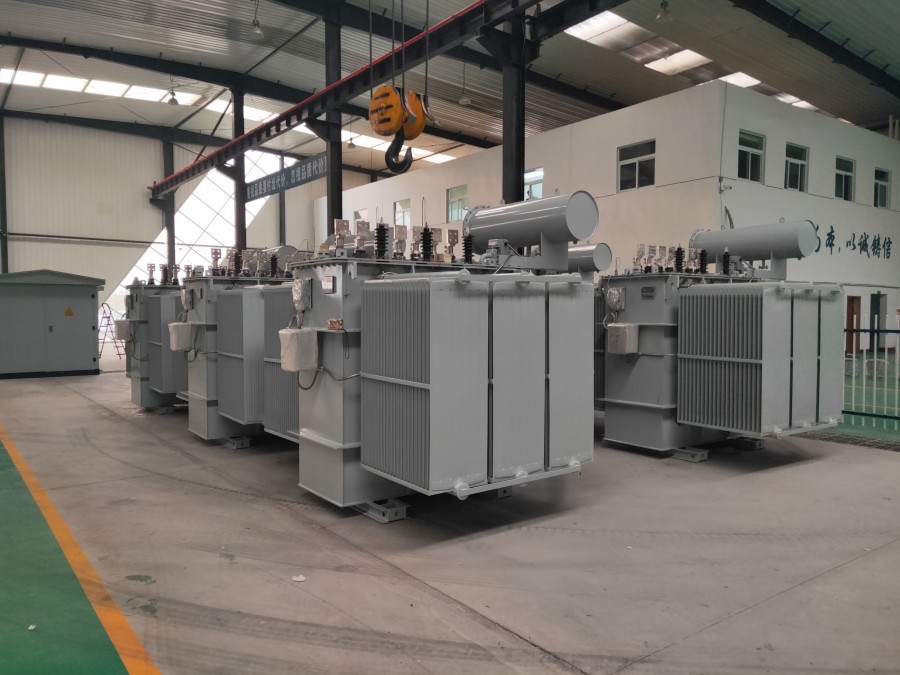
It is worth being clear about one thing at the start: a step up transformer does not create energy. It trades voltage for current, and real-world performance is determined by no-load loss, load loss, impedance and cooling. Procurement teams that understand this basic mechanic are far better equipped to compare quotations from different suppliers on equal terms.
Modern step up transformers are built in several configurations, each suited to a different environment, budget and load profile.
Voltage class is a second dividing line. Distribution-level equipment usually operates at 10 kV, while 35 kV transformers serve larger industrial plants, regional substations and renewable energy projects. Units are commonly supplied from 30 to 6300 kVA, with larger ratings available as engineered designs.
The classic power chain runs like this: a generator produces electricity at a moderate voltage, a step up transformer raises it for transmission, and step down transformers reduce it again for distribution and end use. The same logic applies on a smaller scale inside factories, where a step up transformer may feed a specific high-voltage process, an electrostatic precipitator or a testing facility.
Renewable energy has made this role even more prominent. A solar farm or wind cluster typically generates at low voltage, so a renewable energy transformer is used to lift the output to the grid connection point. Because inverter-driven and turbine-driven sources produce harmonics and fluctuating loads, the transformer specification in these projects deserves particular attention.
Anyone comparing a step up transformer price should first make sure the quotes describe equivalent equipment. The following parameters should always be fixed in writing:
Matching these details to the actual site conditions avoids the most expensive category of mistake: a transformer that is technically functional but does not fit the load, the ambient temperature or the harmonic environment.
Buying through multiple layers of resellers adds margin without adding engineering value. Sourcing directly from a transformer manufacturer typically means lower unit cost, faster delivery from existing inventory and a clearer line of technical accountability. It also makes it easier to request non-standard voltage ratios, special impedance values or a fully custom special transformer when a project does not fit catalogue designs.
Runsheng Transformer Co., Ltd. is an example of this manufacturing model. The company produces S22, S20, S11 and S13 oil-immersed transformers, SCB13, SCB14 and SCB18 dry-type transformers, SH15 amorphous alloy transformers, 35 kV and below preassembled substation equipment, and specialist units including mining transformers and rectifier transformers. Products ship with manuals, inspection reports and test certificates, and are covered by lifelong quality tracking.
A step up transformer is a long-life asset, often expected to operate for decades with minimal intervention. Getting the specification right, verifying the supplier's credentials and buying from the source all reduce risk far more effectively than chasing the lowest quotation. Buyers who understand turns ratio, loss values and cooling requirements will always negotiate from a stronger position — and will end up with equipment that performs as promised.
For specifications, drawings or a factory-direct quotation on oil-immersed, dry-type or custom step up transformer units, contact Runsheng Transformer Co., Ltd. directly: phone +86 13406394988, e-mail runsheng@7813transformer.com, or WhatsApp 008613508930968.

Runsheng Transformer Co., Ltd. is a professional manufacturer of power transformers, specializing in oil-immersed transformers (S20, S11, S13), SH15 amorphous alloy transformers, S13 series 10KV 3D magnetic path wound-core transformers, D10 single-phase wound-core transformers, as well as mining transformers, rectifier transformers, surge arrestor transformers, load-tap-changing transformers, and custom-engineered special transformers.
WhatsApp & Wechat

No. 6, Intersection of Mount Huangshan Road and Changjiang Road, Liaocheng High tech Industrial Development Zone, Shandong, China


