
When you have coordination challenges, turn to Runsheng Transformer for help
It's all about making things easy, building partnerships, and providing a point of contact.
A step up transformer is an electrical device that raises alternating current voltage from a lower level to a higher level while reducing current in the same proportion. Because power loss in a conductor rises with the square of the current, transmitting energy at higher voltage and lower current is far more efficient over long distances. That single principle is the reason generation plants, renewable energy farms and industrial plants all rely on a step up transformer at some point in the chain.
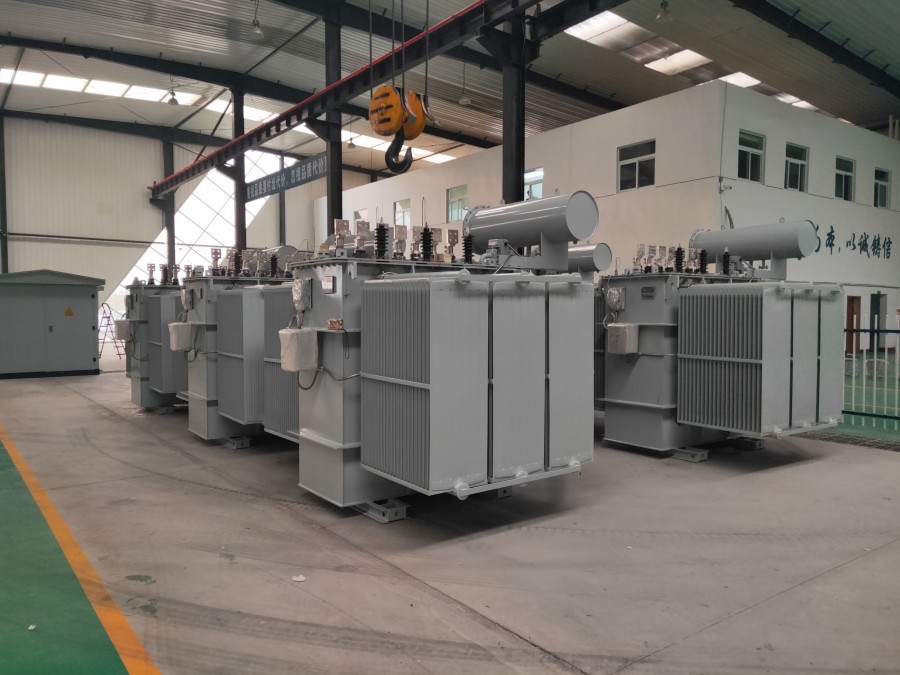
For buyers, the practical questions are rarely theoretical. They are: what rating do I need, which type fits my site, what does a fair price look like, and how do I avoid buying an oversized or under-specified unit? This overview answers those questions in plain terms.
The operation is based on electromagnetic induction. Two or more windings share a common magnetic circuit, usually a laminated silicon steel core. When alternating current flows through the primary winding, it creates a changing magnetic flux in the core, which induces a voltage in the secondary winding.
The voltage relationship follows the turns ratio: the secondary voltage divided by the primary voltage equals the number of secondary turns divided by the number of primary turns. A unit with more turns on the secondary side is a step up transformer; a unit with more turns on the primary side is a step down transformer.
Two construction families dominate commercial supply, and the choice between them usually comes down to site conditions rather than price alone.
Single-phase and three-phase versions are both available, and preassembled substation equipment such as European-style and American-style compact substations packages the transformer together with high and low voltage switchgear in one enclosure.
Supplying incomplete data is the most common reason for delays, returns and rework. A reliable quotation needs the following parameters confirmed in writing.
Two step up transformers with the same kVA rating can differ significantly in price. The main drivers are conductor material and weight, core material and grade, insulation system, loss performance, accessories such as tap changers and monitoring devices, and the testing regime applied before shipment.
It helps to compare total cost of ownership rather than sticker price. A low-loss unit may cost more initially but can recover the difference through reduced electricity charges over years of continuous operation. Conversely, an oversized unit wastes capital and runs at poor loading, while an undersized unit overheats and shortens its own service life. Sizing on actual load profile, with a sensible future growth margin, is the single most effective way to control both capital and operating cost.
As a power transformer manufacturer with a broad production range, Runsheng Transformer Co., Ltd. maintains comprehensive inventory and supplies oil-immersed transformers at factory-direct prices, so buyers avoid layers of intermediary margin. Every unit is delivered with a manual, inspection report, test certificate and lifelong quality tracking.
A step up transformer is a long-life asset, and the cheapest quote is rarely the lowest-cost decision. Define your voltage ratio, capacity, impedance, cooling and loss requirements first, then compare suppliers on technical compliance, test documentation and real delivered price. Get the specification right at the start and the equipment will quietly do its job for decades.
For specification support, quotations or custom designs, contact Runsheng Transformer Co., Ltd.: phone +86 13406394988, e-mail runsheng@7813transformer.com, WhatsApp 008613508930968.

Runsheng Transformer Co., Ltd. is a professional manufacturer of power transformers, specializing in oil-immersed transformers (S20, S11, S13), SH15 amorphous alloy transformers, S13 series 10KV 3D magnetic path wound-core transformers, D10 single-phase wound-core transformers, as well as mining transformers, rectifier transformers, surge arrestor transformers, load-tap-changing transformers, and custom-engineered special transformers.
WhatsApp & Wechat

No. 6, Intersection of Mount Huangshan Road and Changjiang Road, Liaocheng High tech Industrial Development Zone, Shandong, China


