
When you have coordination challenges, turn to Runsheng Transformer for help
It's all about making things easy, building partnerships, and providing a point of contact.
A step down transformer is a static electrical device that converts a higher alternating voltage at its primary winding into a lower voltage at its secondary winding. It is the workhorse of every power distribution network: electricity is generated and transmitted at high voltage to limit line losses, then reduced in stages before it reaches the equipment that actually uses it.
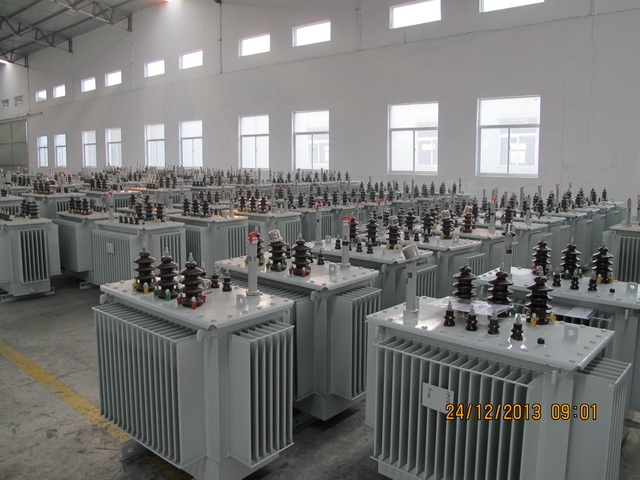
Because a step down transformer has no rotating parts, it is quiet, highly efficient and remarkably durable. A well-made unit can run continuously for decades, which is exactly why the specification and the supplier you choose matter far more than a small difference in the purchase price.
Two or more windings share a laminated magnetic core. Alternating current flowing in the primary winding creates a changing magnetic flux inside the core, and that flux induces a voltage in the secondary winding. The relationship is simple and predictable:
Losses appear as no-load loss (core loss) and load loss (copper loss). These two figures, not the nameplate price alone, determine how much the unit will cost you to run for the next 20 years.
Before you compare quotations, make sure every offer is built on the same technical basis:
Every intermediary between the production line and your site adds margin, and often adds confusion about actual specifications. Buying straight from the manufacturer means you can specify the winding material, loss level, tap range and enclosure you need, and receive the test reports that prove it was built that way.
Runsheng Transformer Co., Ltd. manufactures S22, S20, S11 and S13 oil-immersed transformers, SCB13, SCB14 and SCB18 dry-type transformers, SH15 amorphous alloy transformers, 35kV three-dimensional wound core units, plus mining, rectifier and other custom-designed special transformers. The company also supplies 35kV and below preassembled substation equipment, including European-style and American-style compact substations and high/low-voltage switchgear. Units ship with manuals, inspection reports, test certificates and lifelong quality tracking.
Mount the unit on a level, well-ventilated foundation with adequate clearance for cooling and inspection. Verify the tap changer position matches the actual supply voltage before energizing, and always follow the manufacturer's earthing instructions. Routine maintenance is straightforward: check oil level and oil quality on oil-immersed units, inspect bushings and connections for hot spots, clean dry-type windings and verify that temperature controllers and cooling fans operate correctly.
A step down transformer cannot be used to raise voltage — that requires a step up transformer, although a two-winding unit can be connected in reverse only if it was specifically designed for it. For indoor use, a dry-type unit is usually the safer choice. For outdoor distribution on a budget, an oil-immersed S11 or S13 unit remains the practical standard, while S20 and S22 models offer lower losses for energy-conscious projects.
Choosing a step down transformer is ultimately a decision about total cost of ownership. Confirm the parameters, insist on certified test data and work with a manufacturer who will still answer the phone years after delivery.
Contact Runsheng Transformer Co., Ltd. for factory-direct pricing and technical selection support: phone +86 13406394988, e-mail runsheng@7813transformer.com, WhatsApp 008613508930968.

Runsheng Transformer Co., Ltd. is a professional manufacturer of power transformers, specializing in oil-immersed transformers (S20, S11, S13), SH15 amorphous alloy transformers, S13 series 10KV 3D magnetic path wound-core transformers, D10 single-phase wound-core transformers, as well as mining transformers, rectifier transformers, surge arrestor transformers, load-tap-changing transformers, and custom-engineered special transformers.
WhatsApp & Wechat

No. 6, Intersection of Mount Huangshan Road and Changjiang Road, Liaocheng High tech Industrial Development Zone, Shandong, China


