
When you have coordination challenges, turn to Runsheng Transformer for help
It's all about making things easy, building partnerships, and providing a point of contact.
An autotransformer is a transformer in which the primary and secondary circuits share at least part of a single continuous winding. Instead of two magnetically coupled but electrically separate coils, the autotransformer uses one winding split into a common winding and a series winding, with the load tapped from a point along that winding. Because only the voltage difference between input and output is actually transformed, an autotransformer moves a large block of power while magnetically converting only a fraction of it. That single fact explains why it is smaller, lighter, more efficient, and considerably cheaper than an isolation transformer of the same throughput rating.
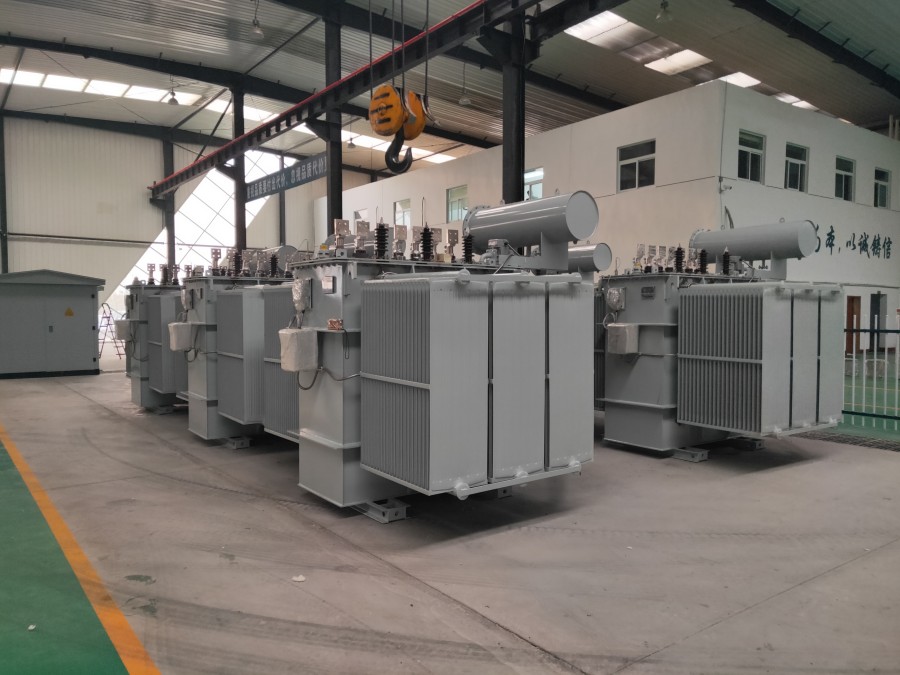
The electrical relationship is straightforward: volts per turn are identical along the whole winding, so tapping at 80% of the turns delivers 80% of the input voltage. For a step-down unit the ratio of transformed power to throughput power is 1 − (V2/V1). A 10% voltage correction therefore means only about 10% of the load power passes through magnetic transformation; the remaining 90% is conducted directly.
Autotransformers appear in several industrially important forms, each with its own procurement logic:
Typical applications include voltage correction on long distribution feeders, interconnection of 110 kV, 220 kV, and 400 kV networks, railway traction supply, starting of large induction motors, renewable energy collection systems needing a modest voltage boost, and test facilities requiring a smooth adjustable supply. In each case the engineering rationale is identical: transfer a large amount of power while transforming only a small proportion of it.
The two most expensive mistakes in autotransformer procurement are opposite sides of the same coin. The first is paying a distributor markup on a commodity unit. The second is buying the cheapest offer and later discovering the windings are aluminum rather than copper, the core steel is low grade, or the stated kVA was measured at an unrealistic temperature rise.
Buy factory direct, and judge each offer on total owning cost rather than purchase price: capitalized no-load and load losses over a 20-year service life usually dwarf the initial gap between a premium design and an economy one. Ask for guaranteed losses, impedance, and temperature rise in writing, and insist on routine tests — ratio, winding resistance, impedance and load loss, no-load loss and current, dielectric tests, and induced overvoltage — plus a type-test report for the design family.
As an established transformer manufacturer holding extensive stock, Runsheng Transformer Co., Ltd. supplies oil-immersed and dry-type units at factory-direct prices, including custom-built autotransformer designs, each shipped with manuals, inspection reports, test certificates, and lifelong quality tracking.
Because there is no galvanic barrier, protection coordination deserves real attention. Earth the neutral according to the system grounding philosophy, verify that upstream and downstream devices discriminate correctly, and confirm that anyone working on the secondary side understands the back-feed risk from the primary. For oil-immersed units, schedule dissolved gas analysis and oil dielectric testing from year one; for dry-type units, keep the windings clean and monitor winding temperature and partial discharge during annual inspections. Torque-check tap links and terminal connections after the first thermal cycle, and log loading against ambient temperature so that any sustained overload is visible before insulation ageing accelerates.
For technical selection support or a quotation on an autotransformer, contact Runsheng Transformer Co., Ltd. by phone at +86 13406394988, by e-mail at runsheng@7813transformer.com, or via WhatsApp at 008613508930968.

Runsheng Transformer Co., Ltd. is a professional manufacturer of power transformers, specializing in oil-immersed transformers (S20, S11, S13), SH15 amorphous alloy transformers, S13 series 10KV 3D magnetic path wound-core transformers, D10 single-phase wound-core transformers, as well as mining transformers, rectifier transformers, surge arrestor transformers, load-tap-changing transformers, and custom-engineered special transformers.
WhatsApp & Wechat

No. 6, Intersection of Mount Huangshan Road and Changjiang Road, Liaocheng High tech Industrial Development Zone, Shandong, China


