
When you have coordination challenges, turn to Runsheng Transformer for help
It's all about making things easy, building partnerships, and providing a point of contact.
ONAN stands for Oil Natural Air Natural, a cooling classification defined in IEC 60076-2 and used across the vast majority of oil-immersed distribution transformers in service today. In an ONAN transformer, the insulating oil inside the tank absorbs heat from the windings and core, rises by natural convection, flows through the radiator fins or corrugated tank walls, and releases that heat into the surrounding air. No oil pumps. No cooling fans. No auxiliary power supply. Every movement is driven by thermodynamics alone.
That simplicity is precisely why the ONAN transformer remains the default choice for utility distribution networks, industrial plants, commercial buildings, and renewable energy projects. Fewer moving parts means fewer failure points, lower maintenance cost, and decades of stable operation. When engineers specify an oil-immersed transformer for a 30–6300 kVA distribution duty, ONAN is usually the baseline cooling class they compare everything else against.
The thermal loop inside an ONAN transformer follows a predictable path. Understanding it helps buyers judge whether a quoted design is realistic for their load profile.
Because the process depends on ambient temperature and natural airflow, ONAN transformer installations need adequate spacing between units, unobstructed ventilation, and sensible site orientation. Place two units too close together, or box them into a sealed room, and the effective cooling capacity drops — along with the transformer's usable service life.
ONAF (Oil Natural Air Forced) adds fans that push air across the radiators, allowing the same core-and-coil assembly to carry a higher load. OFAF goes further with forced oil circulation. The trade-offs are straightforward.
For most 10 kV and 35 kV distribution applications, a well-designed ONAN transformer delivers the best balance of reliability, cost, and efficiency. Overspecifying a cooling class simply adds equipment that needs servicing without improving the load profile.
A credible quotation for an ONAN transformer should always state these values, not just a price and a kVA rating.
The single largest cost difference between two ONAN transformer quotations is rarely the copper or the steel — it is the number of hands the order passes through. A trading company adds margin, lengthens the delivery chain, and often cannot answer technical questions about loss values or insulation design. Buying directly from the manufacturer removes that layer entirely.
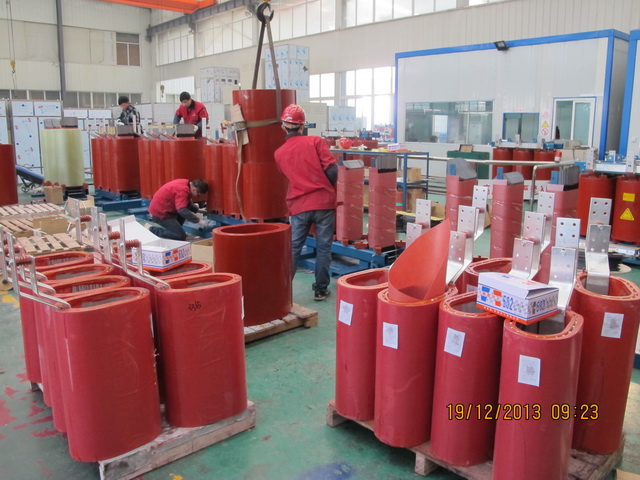
Runsheng Transformer Co., Ltd. is an example of a manufacturer that keeps this structure: production of S11, S13, S20 and S22 oil-immersed transformers, SCB10/SCB13/SCB14/SCB18 dry-type transformers, SH15/SCBH15 amorphous alloy transformers, plus mining transformers, rectifier transformers, load tap changing transformers and custom-designed special transformers, all supplied at factory-direct prices with full documentation. Maintaining a comprehensive inventory also means shorter lead times for standard ratings.
Regardless of supplier, an ONAN transformer should arrive with a complete package. If any item below is missing, treat it as a warning sign.
Undersizing pushes the transformer into sustained overload and accelerates insulation ageing. Oversizing wastes capital and increases no-load loss. A practical approach is to total the connected load, apply a realistic diversity factor, allow 15–25% headroom for future growth, and then check that the resulting ONAN cooling capacity holds under the site's maximum summer ambient temperature. Load tap changing capability may be worth adding where grid voltage fluctuates significantly.
Is an ONAN transformer suitable for outdoor installation? Yes — standard oil-immersed ONAN units are designed for outdoor service, provided clearance and ventilation requirements are met.
How long is the typical service life? With correct loading and oil maintenance, 20 to 30 years is a realistic expectation.
Can ONAN units be upgraded later? In some designs, adding fans (converting to ONAF) can raise capacity, but this should be confirmed with the manufacturer rather than assumed.
When requesting prices, supply the rated capacity, primary and secondary voltages, vector group, frequency, impedance, tap changer type, loss requirements, and site conditions. A manufacturer that asks these questions before quoting is a manufacturer worth working with. For technical consultation or a factory-direct quotation on an ONAN transformer, contact: phone +86 13406394988, e-mail runsheng@7813transformer.com, or WhatsApp 008613508930968.

Runsheng Transformer Co., Ltd. is a professional manufacturer of power transformers, specializing in oil-immersed transformers (S20, S11, S13), SH15 amorphous alloy transformers, S13 series 10KV 3D magnetic path wound-core transformers, D10 single-phase wound-core transformers, as well as mining transformers, rectifier transformers, surge arrestor transformers, load-tap-changing transformers, and custom-engineered special transformers.
WhatsApp & Wechat

No. 6, Intersection of Mount Huangshan Road and Changjiang Road, Liaocheng High tech Industrial Development Zone, Shandong, China


