
When you have coordination challenges, turn to Runsheng Transformer for help
It's all about making things easy, building partnerships, and providing a point of contact.
If you have ever read a transformer nameplate and seen something like "31.5/40 MVA ONAN/ONAF," you have already met an ONAF transformer. ONAF stands for Oil Natural Air Forced. It describes the cooling method, not a separate product family, and it can be applied to oil-immersed transformers from small distribution units to large grid transformers.
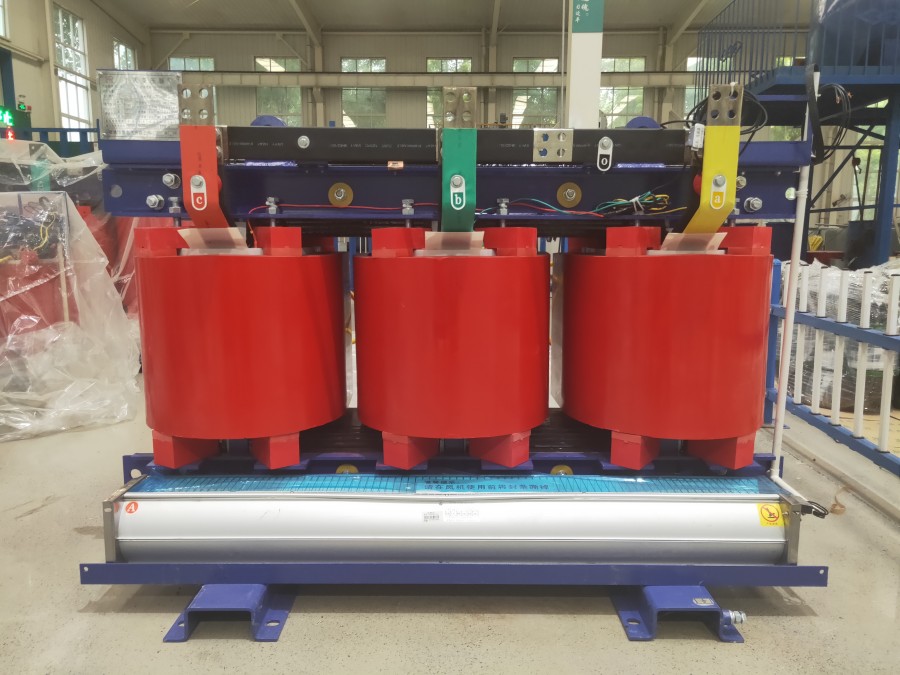
In an ONAF transformer, the insulating oil circulates inside the tank and through the radiator banks by natural convection, driven only by temperature differences. External cooling, however, is boosted by cooling fans that force air across the radiator surfaces. The fans are switched on and off by the control cabinet, usually triggered by winding temperature or top-oil temperature signals. When the fans run, the same transformer can carry considerably more load without exceeding its permitted temperature rise; when they stop, the unit simply continues to run at its lower ONAN rating.
That dual rating is the reason ONAF transformers are so widely specified: they give utilities and industrial plants extra short-term and cyclic overload capability without paying the full price of a larger core-and-coil assembly.
A typical ONAF transformer is built from the following parts, and each of them affects both price and reliability:
ONAF cooling is available across a very wide range. On the distribution side, three-phase oil-immersed units commonly run from 30 kVA to 6300 kVA at 10 kV and 35 kV. On the power side, ONAF designs are used at 66 kV and 110 kV, and occasionally higher, with ratings expressed as dual values such as 40/50 MVA ONAN/ONAF.
Design, testing and temperature-rise limits normally follow IEC 60076, GB 1094 or IEEE C57.12.00, depending on the target market. Buyers should always confirm the specified standard, the ambient temperature basis (for example 40 degrees Celsius maximum), the altitude limit and the required impedance voltage before comparing quotations.
Most problems with an ONAF transformer appear far later than the quotation stage. Watch for suppliers who quote a single rating and quietly omit the ONAF fan set, who use undersized radiators, or who cannot provide type test reports and routine test certificates. Unbranded fans, thin galvanised steel and missing control-cabinet documentation all shorten service life. Extremely low prices usually mean reduced copper, thinner silicon steel or missing accessories rather than a genuine bargain.
Buying directly from a manufacturer removes trading-company mark-ups, shortens the communication chain on technical clarifications and makes it easier to obtain custom designs. As a power transformer manufacturer, Runsheng Transformer Co., Ltd. keeps a broad inventory of oil-immersed and dry-type units, so buyers can often secure a suitable ONAF transformer at factory-direct prices while still receiving full documentation, including manuals, inspection reports and test certificates.
Cooling method is only one decision. Depending on the site, engineers also compare oil-immersed transformers such as the S11, S13, S20 and S22 series, dry-type transformers including SCB10, SCB13, SCB14 and SCB18, and amorphous alloy transformers such as SH15 and SCBH15. For compact installations, 35 kV and below preassembled substations, European-style and American-style compact substations, and high and low voltage switchgear complete the package.
An ONAF transformer is a cost-efficient way to gain 20% to 33% more capacity from the same footprint, provided the radiators, fans and control system are properly specified. Compare quotations on rating, losses, standards and documentation rather than price alone, and confirm that the supplier offers lifelong quality tracking after delivery.
For technical selection support or a quotation, contact Runsheng Transformer Co., Ltd.: phone +86 13406394988, e-mail runsheng@7813transformer.com, WhatsApp 008613508930968.

Runsheng Transformer Co., Ltd. is a professional manufacturer of power transformers, specializing in oil-immersed transformers (S20, S11, S13), SH15 amorphous alloy transformers, S13 series 10KV 3D magnetic path wound-core transformers, D10 single-phase wound-core transformers, as well as mining transformers, rectifier transformers, surge arrestor transformers, load-tap-changing transformers, and custom-engineered special transformers.
WhatsApp & Wechat

No. 6, Intersection of Mount Huangshan Road and Changjiang Road, Liaocheng High tech Industrial Development Zone, Shandong, China


