
When you have coordination challenges, turn to Runsheng Transformer for help
It's all about making things easy, building partnerships, and providing a point of contact.
Few purchasing decisions in a power distribution project carry as much long-term weight as choosing an oil immersed power transformer. A well-matched unit quietly delivers decades of stable, low-loss service. A poorly chosen one brings overheating, inflated no-load losses, unplanned outages and, all too often, a supplier that stops answering the phone the moment a fault appears. This overview covers the fundamentals: what an oil immersed power transformer actually is, how it works, which model series dominate the market, which parameters matter, and how to buy factory-direct instead of paying a layer of middleman margin.
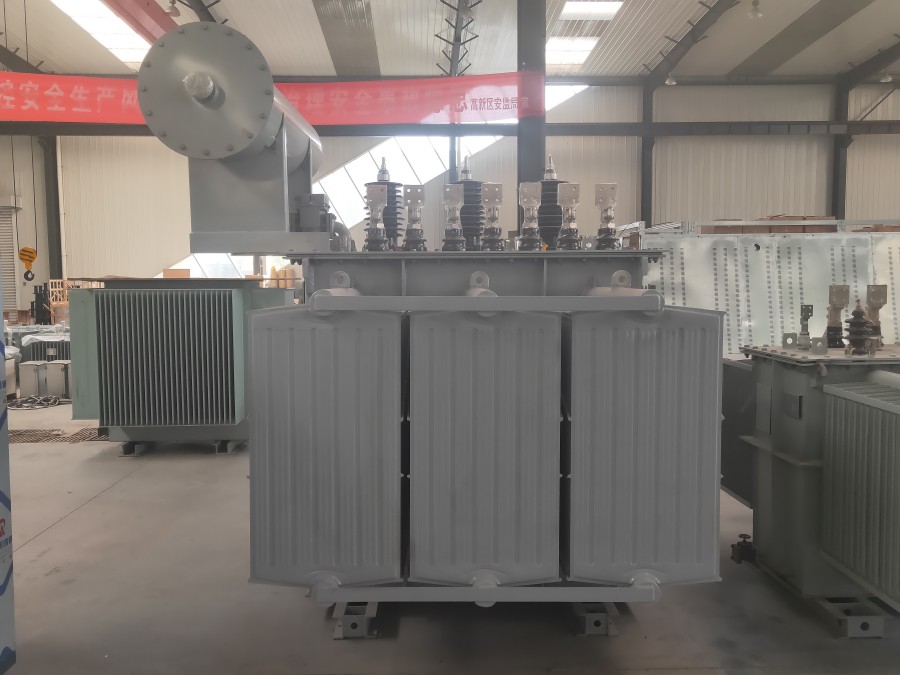
An oil immersed power transformer is a static electrical device that transfers electrical energy between two or more circuits through electromagnetic induction, using insulating oil as both the dielectric medium and the cooling agent. The active part, consisting of a magnetic core and copper or aluminium windings, is fully submerged in transformer oil inside a sealed steel tank. Heat produced by core losses and copper losses is carried away from the windings by natural oil convection (ONAN cooling) or forced circulation (ONAF and OFAF), then dissipated through the tank walls, radiators or corrugated fins.
Oil immersion delivers three practical benefits: dielectric strength far higher than air, excellent heat transfer, and reliable long-term operation in humid, dusty or fully outdoor environments. This is precisely why oil immersed distribution transformers dominate medium-voltage networks from 10 kV through 35 kV.
Model numbers are not marketing noise; they encode loss class and construction. The letter S indicates a three-phase unit, and the following number indicates the energy-efficiency tier. The higher the figure, the lower the no-load loss and the lower the running cost over a 20 to 30 year lifespan.
Standard capacity coverage runs from 30 kVA to 6300 kVA, with voltage classes at 10 kV, 20 kV and 35 kV.
Oil immersed power transformers generally cost less per kVA, handle higher capacities more economically, run cooler outdoors and tolerate harsh environments. Dry-type units, such as SCB10, SCB13, SCB14 and SCB18, avoid oil and suit indoor locations with strict fire requirements. Choosing between them comes down to capacity, installation environment, fire code and total lifecycle cost.
A quotation that looks dramatically cheaper almost always reflects a substitution somewhere in this list. That is the single most common pitfall buyers encounter.
As a power transformer manufacturer, Runsheng Transformer Co., Ltd. produces S22, S20, S11 and S13 oil immersed transformers, SH15 amorphous alloy transformers, three-dimensional wound core units, mining and rectifier transformers, plus 35 kV and below preassembled substation equipment and high and low voltage switchgear. Products are supplied at factory-direct prices with manuals, inspection reports, test certificates and lifelong quality tracking, so the documentation trail stays intact from delivery through to end of service.
For procurement teams, that means one less mark-up in the chain and a direct technical contact when specifications need adjusting.
Phone: +86 13406394988 | Email: runsheng@7813transformer.com | WhatsApp: 008613508930968

Runsheng Transformer Co., Ltd. is a professional manufacturer of power transformers, specializing in oil-immersed transformers (S20, S11, S13), SH15 amorphous alloy transformers, S13 series 10KV 3D magnetic path wound-core transformers, D10 single-phase wound-core transformers, as well as mining transformers, rectifier transformers, surge arrestor transformers, load-tap-changing transformers, and custom-engineered special transformers.
WhatsApp & Wechat

No. 6, Intersection of Mount Huangshan Road and Changjiang Road, Liaocheng High tech Industrial Development Zone, Shandong, China


