
When you have coordination challenges, turn to Runsheng Transformer for help
It's all about making things easy, building partnerships, and providing a point of contact.
A dry type transformer is a static electrical device that transfers electrical energy between circuits through electromagnetic induction, with one important difference from a conventional distribution transformer: its core and windings are cooled by air rather than by insulating oil. There is no liquid dielectric anywhere in the unit, which is exactly why it is called "dry type".
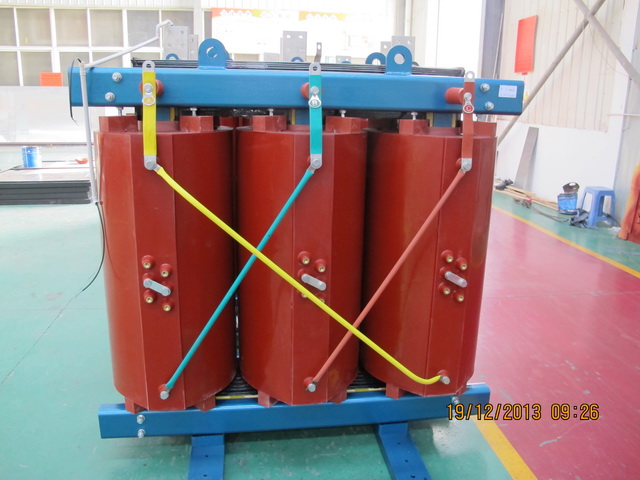
Every dry type transformer is built from three essential elements: a magnetic core made of grain-oriented silicon steel or amorphous alloy, high and low voltage windings wound in copper or aluminium, and a solid insulation system. That insulation system is usually either epoxy resin cast under vacuum (cast resin) or a vacuum pressure impregnated (VPI) resin structure. These materials determine the unit's temperature class, its short-circuit withstand and its service life.
Alternating current flowing through the primary winding creates an alternating magnetic flux in the core. The core channels that flux into the secondary winding, where it induces a voltage at a level suitable for the load. Because the windings and core generate heat, dry-type units rely on two cooling methods:
Typical insulation classes are class F (155 degrees C) and class H (180 degrees C), with standard temperature rise of 80K or 100K. This thermal headroom is what makes a well-built dry type transformer resistant to short-term overload and voltage fluctuation.
Series designations are not marketing labels - the digits indicate loss levels and energy efficiency. A lower no-load loss figure means lower electricity bills over the unit's 20-30 year life, which is why efficiency grade matters far more than purchase price in a lifetime cost calculation.
Procurement mistakes almost always trace back to an incomplete specification. Confirm these items in writing on every quotation:
Choosing between technologies is a question of environment and duty:
Because they are quiet, non-flammable and maintenance-light, dry-type units dominate commercial and critical-power applications: hospitals, shopping malls and office towers, data centres, metro and airport projects, semiconductor and food plants, ships and offshore platforms, plus solar and wind farms where a renewable energy transformer must operate indoors or in enclosures.
Buyer beware is real in this market. Watch for these common traps:
Four factors explain most of the price difference between quotations: winding material and conductor cross-section, cast resin versus VPI insulation, efficiency grade (SCB10 through SCB18), and capacity or voltage class. Enclosure type, forced-air cooling and third-party testing also move the number. When two quotes differ by 30%, the difference is almost never the factory - it is the specification or the supply chain.
As a power transformer manufacturer, Runsheng Transformer Co., Ltd. produces SCB10, SCB13, SCB14 and SCB18 dry-type transformers, SGB10 units, SH15 amorphous alloy transformers, S11/S13/S20/S22 oil-immersed transformers, mining and rectifier transformers, plus 35 kV preassembled substation equipment and high/low voltage switchgear. Because units ship directly from the production line, buyers avoid distributor mark-ups, and every order is delivered with manuals, inspection reports, test certificates and lifelong quality tracking.
The practical takeaway for procurement teams is simple: fix the efficiency grade and loss figures first, compare like-for-like specifications second, and only then compare price. Bought that way, a factory-direct dry type transformer typically lands 20-30% below list-channel pricing while still meeting IEC and national standards.
For specifications, drawings or a factory-direct quotation, contact Runsheng Transformer Co., Ltd. by phone at +86 13406394988, e-mail runsheng@7813transformer.com, or WhatsApp 008613508930968.

Runsheng Transformer Co., Ltd. is a professional manufacturer of power transformers, specializing in oil-immersed transformers (S20, S11, S13), SH15 amorphous alloy transformers, S13 series 10KV 3D magnetic path wound-core transformers, D10 single-phase wound-core transformers, as well as mining transformers, rectifier transformers, surge arrestor transformers, load-tap-changing transformers, and custom-engineered special transformers.
WhatsApp & Wechat

No. 6, Intersection of Mount Huangshan Road and Changjiang Road, Liaocheng High tech Industrial Development Zone, Shandong, China


