
When you have coordination challenges, turn to Runsheng Transformer for help
It's all about making things easy, building partnerships, and providing a point of contact.
An ODAF transformer is an oil-immersed power transformer whose cooling class is defined as Oil Directed Air Forced. Two things happen at the same time. First, oil pumps push the insulating oil through directed ducts inside the windings, so the oil does not simply drift upward by natural convection, it is guided across the hottest conductor surfaces. Second, fans force air across the radiator banks or oil-to-air heat exchangers, multiplying the heat that can be rejected to the atmosphere.
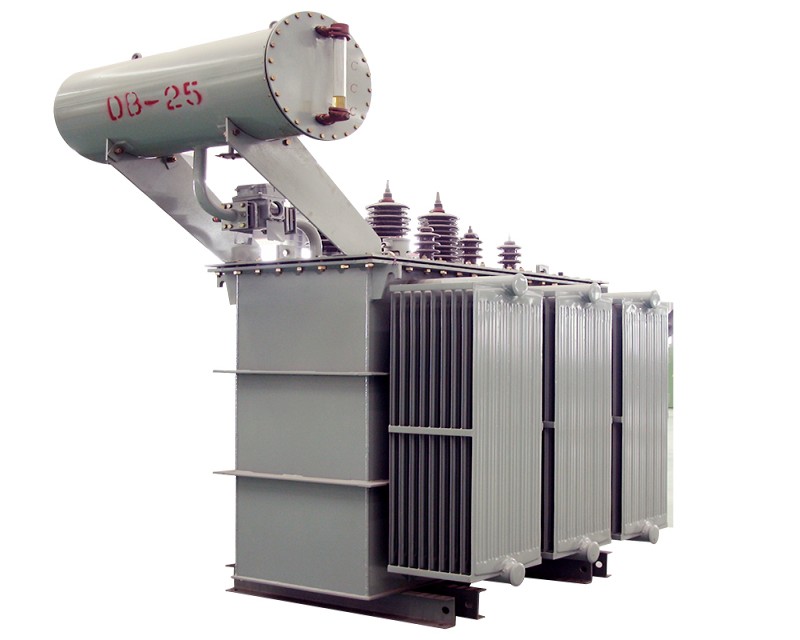
The result is a transformer that can carry far more load in the same tank and core size than a free-breathing ONAN unit. That is exactly why ODAF transformer designs appear in substations, renewable energy projects, industrial plants and heavy-duty installations where space is tight but demand keeps climbing. For anyone comparing offers, ODAF is a cooling class, not a brand, and it must be matched carefully to the load profile, ambient temperature and altitude of the site.
In an ODAF transformer, the oil circuit is an engineered hydraulic system rather than a passive one. A pump draws cooled oil from the bottom of the tank or from the cooler outlet and delivers it into the winding ducts, where it absorbs heat from the conductors and the insulation. The warmed oil leaves the top of the winding, passes through radiators or heat exchangers, is cooled by forced air from fan banks, and returns to the pump inlet.
Most large units are supplied as multi-stage designs, for example ONAN/ONAF/ODAF or ONAN/ODAF. At light load the transformer runs quietly on natural cooling. As load and temperature rise, fans start, and at the highest stage the oil pumps engage. This staged logic saves auxiliary energy and reduces noise during low-load periods, while still delivering the full rated capacity when it is needed.
Because directed oil flow targets the conductor surface directly, an ODAF transformer typically achieves higher winding gradients than a natural-flow design while keeping the hot spot within the limits set by IEC 60076-2 and equivalent national standards such as GB 1094. The practical benefit is more megavolt-amperes from a given core and coil, plus better performance under cyclic and emergency loading.
In all of these duties the ODAF transformer is chosen for one reason: it holds its temperature under sustained overload and high ambient conditions where a simpler cooling class would have to be de-rated.
A well-built ODAF transformer can serve for decades when it is maintained properly. Routine work covers oil sampling and dissolved gas analysis, dissolved moisture checks, pump and fan inspection, cooler cleaning, gasket and bushing checks, and verification of the cooling control cabinet logic. Oil flow indicators and pressure gauges should be read at every inspection, because a stalled pump reduces capacity exactly when the load is highest.
Cooling class, winding design and test data are decided at the factory, not in a trading office. Working directly with a manufacturer gives you access to the design review, the ability to customise the ODAF transformer for your ambient, altitude and load cycle, and full documentation with every unit. Runsheng Transformer Co., Ltd., a power transformer manufacturer, produces oil-immersed transformer ranges such as the S11, S13, S20 and S22 series, dry-type SCB10, SCB13, SCB14 and SCB18 units, SH15 amorphous alloy transformers, mining transformer and rectifier transformer types, load tap changing transformer designs, plus 35kV transformer and below compact substation and preassembled substation equipment. Units ship with manuals, inspection reports, test certificates and lifelong quality tracking, so procurement teams get factory-direct pricing without giving up verification.
Before you place an order, ask for the cooling stage ratings, the temperature rise calculation, the auxiliary power consumption and the routine test report. Those four documents tell you more about an ODAF transformer than any glossy brochure. Contact: phone +86 13406394988, e-mail runsheng@7813transformer.com, WhatsApp 008613508930968.

Runsheng Transformer Co., Ltd. is a professional manufacturer of power transformers, specializing in oil-immersed transformers (S20, S11, S13), SH15 amorphous alloy transformers, S13 series 10KV 3D magnetic path wound-core transformers, D10 single-phase wound-core transformers, as well as mining transformers, rectifier transformers, surge arrestor transformers, load-tap-changing transformers, and custom-engineered special transformers.
WhatsApp & Wechat

No. 6, Intersection of Mount Huangshan Road and Changjiang Road, Liaocheng High tech Industrial Development Zone, Shandong, China


