
When you have coordination challenges, turn to Runsheng Transformer for help
It's all about making things easy, building partnerships, and providing a point of contact.
A three phase transformer is the workhorse of modern power distribution. It steps medium-voltage supply down to the 400/415 V used by factories, commercial buildings and utilities, or steps generation voltage up for transmission. Because three phases share one core and one tank, a single unit is smaller, lighter and cheaper than three separate single-phase units of the same rating, which is why it dominates industrial and utility networks worldwide.
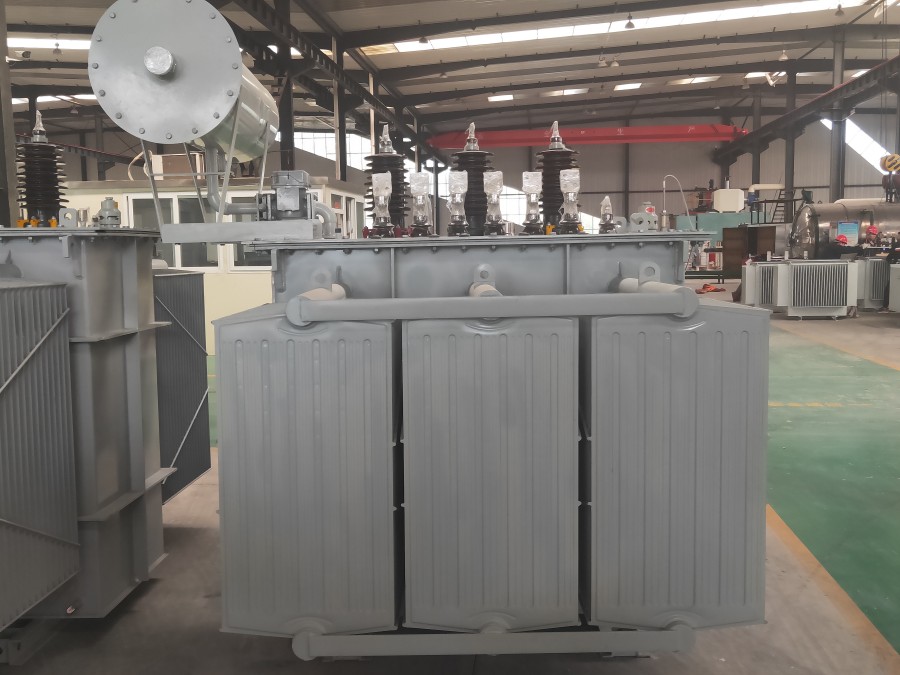
Three alternating currents, displaced by 120 electrical degrees, flow through three windings linked by a common magnetic circuit. In a three-limb core the fluxes sum to zero under balanced load, so no return limb is needed and the core stays compact. The result is a stable voltage ratio, high efficiency and a design that fits standard switchgear, cable boxes and protection schemes.
The magnetic core is built from thin, insulated silicon steel laminations, or from amorphous alloy ribbon when very low no-load loss is required. Windings are normally copper or aluminium conductors, wound in layers or discs and insulated with class A, E, B or F materials depending on the temperature rise allowed by the design. Insulation, clamping pressure and drying quality decide short-circuit strength and service life far more than appearance does. A well-built three phase transformer should show tight dimensional control, clean oil or cast resin, and consistent winding resistance between phases.
Both families use the same electromagnetic principle, but they suit different sites and budgets.
Procurement should read the nameplate as a technical contract, not a label. The following values determine both the quotation and the long-term electricity bill.
No-load loss is consumed 24 hours a day, whether the plant is busy or idle, while load loss rises with the square of the current. A cheap transformer with poor loss figures can cost more over ten years than a slightly dearer high-efficiency unit. Serious buyers compare quotations using a loss evaluation formula, capitalising each kilowatt of no-load and load loss at the local electricity tariff and expected operating hours. This is the fastest way to see whether a premium design pays back in two, three or five years.
Every unit should ship with routine test reports covering winding resistance, voltage ratio, vector group, no-load loss and current, load loss and impedance, applied voltage and induced voltage tests. Oil-immersed units also need dielectric oil tests, and cast-resin units need partial discharge records. Type test certificates, an inspection report, a manual and a quality tracking record are not paperwork extras; they are evidence for warranty claims and grid approval. Cutting these documents to save a few dollars is a classic pitfall.
As a transformer manufacturer with a broad inventory, Runsheng Transformer Co., Ltd. supplies oil-immersed, dry-type and amorphous alloy units at factory-direct prices, with manuals, inspection reports, test certificates and lifelong quality tracking. That combination of stock availability and documented quality keeps project schedules and budgets under control.
Correct installation protects the investment: adequate ventilation, clean cable terminations, proper earthing, and protection settings matched to the impedance. Oil-immersed units need periodic oil level, leakage and dielectric checks; dry-type units need cleaning of air ducts and tightening of connections. Keeping a load log helps identify overload or harmonic problems early and supports planned replacement instead of emergency failure.
Whether the requirement is a standard distribution unit, a 35 kV transformer, a mining or rectifier transformer, or a complete compact substation, matching the specification to the actual duty is what separates a good purchase from a costly mistake. For technical selection support and a factory-direct quotation, contact Runsheng Transformer Co., Ltd. by phone at +86 13406394988, e-mail at runsheng@7813transformer.com or WhatsApp at 008613508930968.

Runsheng Transformer Co., Ltd. is a professional manufacturer of power transformers, specializing in oil-immersed transformers (S20, S11, S13), SH15 amorphous alloy transformers, S13 series 10KV 3D magnetic path wound-core transformers, D10 single-phase wound-core transformers, as well as mining transformers, rectifier transformers, surge arrestor transformers, load-tap-changing transformers, and custom-engineered special transformers.
WhatsApp & Wechat

No. 6, Intersection of Mount Huangshan Road and Changjiang Road, Liaocheng High tech Industrial Development Zone, Shandong, China


