
When you have coordination challenges, turn to Runsheng Transformer for help
It's all about making things easy, building partnerships, and providing a point of contact.
Every factory, apartment block, hospital, data centre and solar farm depends on one final step in the power delivery chain: stepping medium voltage down to a voltage that equipment can safely use. That step is performed by the distribution transformer. It takes a 10 kV or 35 kV feeder from the grid and converts it to 400 V / 230 V for end users, or to whatever voltage an industrial process requires.
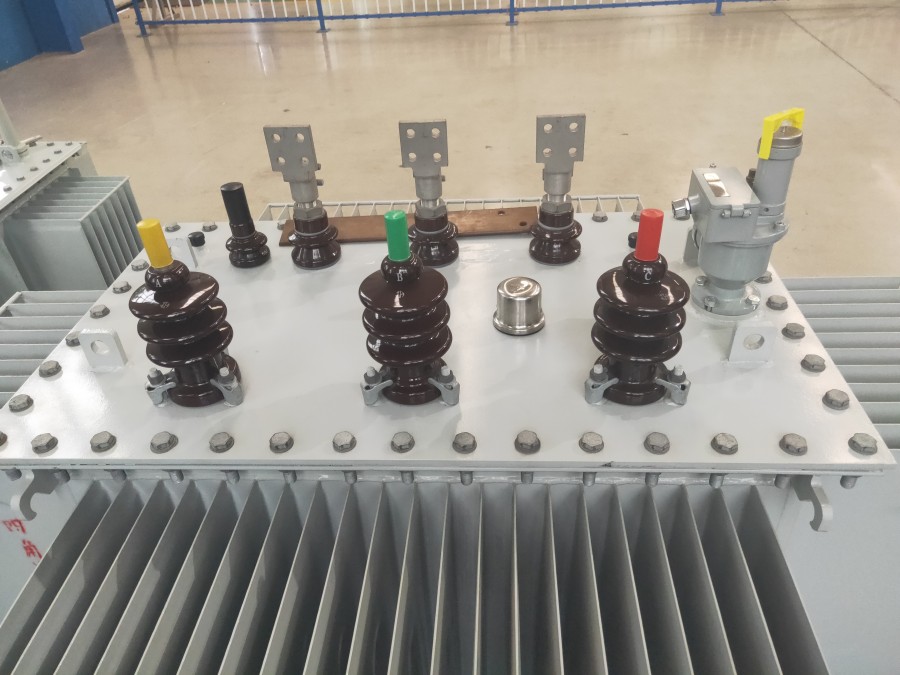
Unlike large power transformers at generating stations, a distribution transformer sits close to the load. That position determines its design priorities: compact footprint, low losses over thousands of hours of operation, low noise, minimal maintenance, and predictable cost. Because utilities and industrial parks buy these units in large quantities, even a small improvement in efficiency has a measurable effect on operating expense.
The unit works on electromagnetic induction. An alternating current in the primary winding creates a changing magnetic flux in the laminated or wound core. That flux induces a voltage in the secondary winding. The ratio of turns between the two windings determines the voltage ratio, while the cross-sectional area and material of the core determine how much energy is lost as heat along the way.
Buyers usually compare two families before anything else: oil-immersed and dry-type. Choosing the wrong family is the most common and most expensive mistake in procurement.
Beyond these, specialised designs exist for particular duties: mining transformers with reinforced enclosures and higher short-circuit withstand, rectifier transformers for electrolysis and smelting, single-phase wound core units for traction and rural single-phase supply, and 10 kV three-dimensional wound core models built on a closed magnetic path for lower loss and quieter operation.
A quotation is only as good as the specification behind it. Insist on the following data in writing, and compare offers on the same basis.
Three commercial levers matter more than haggling over the last few percent of the unit price.
First, calculate lifetime cost. A cheaper unit with higher losses can cost more in electricity within a few years. Comparing purchase price plus ten years of loss cost exposes the real difference between an S11 series unit and an S13, S20 or S22 series unit.
Second, buy from the source. Working directly with a power transformer manufacturer removes agent markup and, more importantly, keeps you in contact with the people who control winding design, core material and test records. As a China transformer supplier serving domestic and export projects, Runsheng Transformer Co., Ltd. maintains a comprehensive inventory of oil-immersed and dry-type units at factory-direct prices, with every shipment accompanied by a manual, inspection report, test certificate and lifelong quality tracking.
Third, verify material and testing, not just the label. Ask for routine test results covering winding resistance, transformation ratio, no-load loss and current, load loss and impedance, insulation resistance, power frequency withstand voltage and, where applicable, impulse test. Confirm that the core steel grade and conductor material match the agreed specification, and that the nameplate mirrors the test certificate.
Correct installation protects the investment. Keep adequate clearance for ventilation, mount dry-type units where air can circulate freely, ensure oil units are level and the oil level is correct before energising, and connect neutral and earthing according to the system design. In service, the practical routine is simple: check temperature readings and oil level, inspect bushings and connections for overheating or dust accumulation, verify the silica gel breather on oil units, and record periodic insulation resistance values. Any upward trend in temperature at unchanged load deserves investigation.
A distribution transformer is not a commodity you buy on price alone. Match the type to the environment, confirm the efficiency grade against your energy cost, insist on complete test documentation, and buy from a manufacturer who will still answer the phone years after delivery. Do that, and the savings show up on both the invoice and the electricity bill.
For specifications, drawings or a quotation on oil-immersed, dry-type, amorphous alloy, mining, rectifier or custom special transformers from 30 to 6300 kVA, contact Runsheng Transformer Co., Ltd. — phone: +86 13406394988, e-mail: runsheng@7813transformer.com, WhatsApp: 008613508930968.

Runsheng Transformer Co., Ltd. is a professional manufacturer of power transformers, specializing in oil-immersed transformers (S20, S11, S13), SH15 amorphous alloy transformers, S13 series 10KV 3D magnetic path wound-core transformers, D10 single-phase wound-core transformers, as well as mining transformers, rectifier transformers, surge arrestor transformers, load-tap-changing transformers, and custom-engineered special transformers.
WhatsApp & Wechat

No. 6, Intersection of Mount Huangshan Road and Changjiang Road, Liaocheng High tech Industrial Development Zone, Shandong, China


