
When you have coordination challenges, turn to Runsheng Transformer for help
It's all about making things easy, building partnerships, and providing a point of contact.
A low voltage transformer is a static electrical device that converts electrical energy from one voltage level to another at a rated voltage of 1 kV or below on at least one side. In everyday industrial and commercial power distribution, the term usually describes the final step-down unit whose secondary winding delivers 380 V, 400 V or 415 V, the working voltage for motors, lighting, HVAC systems, control panels, pumps and building services.
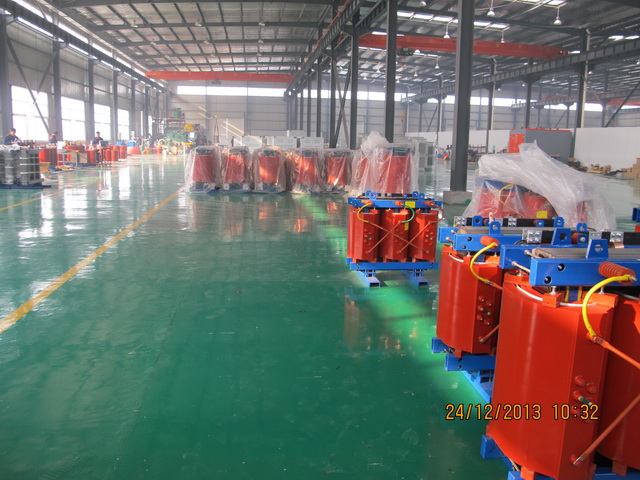
Think of it as the last link in the supply chain. Power arrives from the grid at medium voltage, most commonly 10 kV, 20 kV or 35 kV, and the low voltage transformer brings it down to a level that machinery and people can safely use. Because nearly every facility relies on this conversion step, the choice of unit has a direct effect on energy losses, reliability and long-term operating cost.
The principle is electromagnetic induction. Alternating current in the primary winding creates a changing magnetic flux in the laminated core, and that flux induces a voltage in the secondary winding. The ratio of primary to secondary turns determines the voltage ratio, while the core material and winding conductor determine the losses.
There are no moving parts in a standard low voltage transformer, which is why it can run for decades with minimal maintenance. Modern units achieve efficiencies of roughly 97 to 99 percent, and the difference between a cheap transformer and a well-built one usually hides in two numbers: no-load loss, which runs 24 hours a day, and load loss, which rises with current. Both appear on the nameplate and on the test report, and both show up on your electricity bill every month.
Industrial plants, commercial buildings, water treatment works, mining sites, airports, tunnels, renewable energy projects and electric vehicle charging hubs all depend on this equipment. In renewable energy transformer applications, the unit often sits inside a preassembled substation or compact substation together with high low voltage switchgear, forming a complete packaged solution that is wired and tested before it leaves the factory.
Purchasing a low voltage transformer straight from the production line typically trims 10 to 30 percent off the price compared with multi-layer distribution, and it shortens lead times because the unit does not sit in a warehouse twice. In recent years, manufacturers such as Runsheng Transformer Co., Ltd. have expanded beyond core transformers into 35 kV and below preassembled substation equipment, including European-style and American-style compact substations plus high low voltage switchgear, allowing a single supplier to cover the whole conversion chain from a 30-6300kva transformer through to the switchboard it feeds. Units are supplied with manuals, inspection reports, test certificates and lifelong quality tracking, so buyers keep a traceable record for every piece of equipment on site.
A low voltage transformer is a long-life asset, and the cheapest quotation is rarely the cheapest decision. Compare efficiency, certification, construction quality and after-sales support before you sign, and always ask for the test data. Buyers who source directly from a manufacturer with a complete inventory and documented quality control consistently report lower acquisition costs and fewer surprises during commissioning.
For specifications, pricing or a tailored solution on distribution transformers, dry-type transformers, oil-immersed transformers or complete compact substations, contact:
Phone: +86 13406394988
E-mail: runsheng@7813transformer.com
WhatsApp: 008613508930968

Runsheng Transformer Co., Ltd. is a professional manufacturer of power transformers, specializing in oil-immersed transformers (S20, S11, S13), SH15 amorphous alloy transformers, S13 series 10KV 3D magnetic path wound-core transformers, D10 single-phase wound-core transformers, as well as mining transformers, rectifier transformers, surge arrestor transformers, load-tap-changing transformers, and custom-engineered special transformers.
WhatsApp & Wechat

No. 6, Intersection of Mount Huangshan Road and Changjiang Road, Liaocheng High tech Industrial Development Zone, Shandong, China


