
When you have coordination challenges, turn to Runsheng Transformer for help
It's all about making things easy, building partnerships, and providing a point of contact.
A 400kv power transformer is a piece of extra-high-voltage (EHV) transmission equipment that steps voltage up from a generating station or steps it down between transmission tiers. It sits at the top of the transmission chain, above the more familiar 110 kV, 220 kV and 330 kV classes, and is normally found at the interface between the bulk transmission network and large regional load centres.
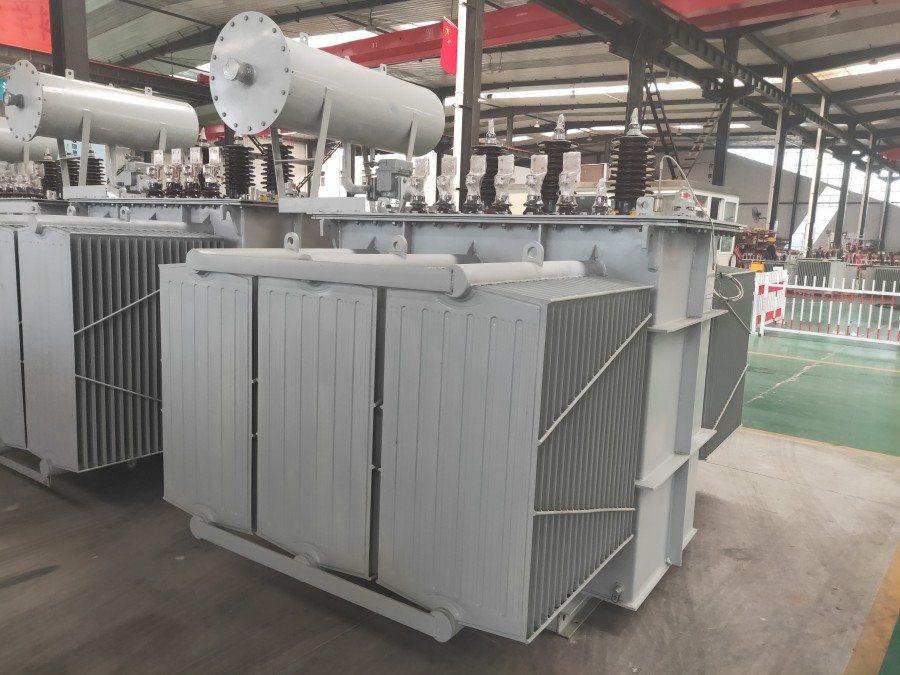
In plain terms, its job is to move large blocks of power over long distances while keeping losses low. Because power loss scales with current, raising voltage is the most efficient way to transport megawatts. That is why 400kv power transformers are built in very large ratings, usually three-phase, oil-immersed, and permanently installed in an outdoor switchyard on a concrete plinth with an oil containment pit.
Although a 400kv power transformer looks like a simple steel tank with bushings, it is one of the most engineered products in the electrical industry. The main elements are consistent across manufacturers:
Typical vector groups for grid duty are YNyn0 or YNd11, and the whole assembly is designed to IEC 60076, IEEE C57.12 or the equivalent national standard.
Price comparisons only make sense when the technical specification is identical. Before requesting quotations, confirm the following on the datasheet:
A unit rated for a cold inland site will not perform the same way as one specified for a hot, humid coastal substation, even if the MVA rating is identical. This is why a supplier that simply quotes a headline price without asking about site conditions is a procurement risk.
Dry-type transformers such as the SCB13, SCB14 and SCB18 families are excellent choices for indoor distribution duty, and they are widely used in buildings, metro systems and industrial plants at medium voltage. At 400 kV, however, oil-immersed construction is effectively the only practical option: the dielectric strength and heat transfer required cannot be met economically by air insulation alone. This is worth remembering when a buyer compares quotations — an oil-immersed EHV unit and a dry-type distribution transformer are not interchangeable products.
For projects working at 35 kV and below, the picture is different. A power transformer manufacturer such as Runsheng Transformer Co., Ltd. covers oil-immersed units in the S11, S13, S20 and S22 series, dry-type SCB10/SCB13/SCB14/SCB18 designs, SH15 and SCBH15 amorphous alloy transformers, mining and rectifier transformers, plus compact substations and high- and low-voltage switchgear — the layer of equipment that connects to, but is distinct from, EHV transmission assets.
A 400kv power transformer cannot be shipped on trust alone. Routine tests normally include winding resistance, voltage ratio, short-circuit impedance, no-load loss and current, load loss, applied and induced voltage dielectric tests, oil tests and partial discharge measurement. Type tests may add lightning impulse, switching impulse and temperature-rise verification, and a factory acceptance test with the buyer present is common practice for units of this size.
Every delivery should arrive with a complete document set: instruction manual, inspection report, routine test certificate and a traceable quality record. This documentation matters as much as the hardware, because it is what insurers, grid operators and future maintenance teams rely on.
Cost is dominated by a handful of factors: core steel grade, copper content and winding design, tap changer make, bushing type, cooling complexity, loss guarantees and transport logistics. A genuine saving does not come from stripping out copper or downgrading insulation — it comes from removing intermediaries.
Buying directly from the production line typically means factory-direct pricing, assured inventory, national-standard compliance, and full access to technical support during specification, installation and commissioning. The most reliable way to save money on a 400kv power transformer is to define the specification precisely, compare like for like, and work with a manufacturer that will put loss figures, test reports and delivery commitments in writing.
Get these five questions answered before signing, and you will avoid the most common and expensive mistakes in EHV transformer procurement.
For enquiries on transformers, substations and switchgear, contact: phone +86 13406394988, e-mail runsheng@7813transformer.com, WhatsApp 008613508930968.

Runsheng Transformer Co., Ltd. is a professional manufacturer of power transformers, specializing in oil-immersed transformers (S20, S11, S13), SH15 amorphous alloy transformers, S13 series 10KV 3D magnetic path wound-core transformers, D10 single-phase wound-core transformers, as well as mining transformers, rectifier transformers, surge arrestor transformers, load-tap-changing transformers, and custom-engineered special transformers.
WhatsApp & Wechat

No. 6, Intersection of Mount Huangshan Road and Changjiang Road, Liaocheng High tech Industrial Development Zone, Shandong, China


