
When you have coordination challenges, turn to Runsheng Transformer for help
It's all about making things easy, building partnerships, and providing a point of contact.
A three winding transformer is a single power transformer built on one magnetic core with three independent sets of windings. Instead of linking just one primary and one secondary, it couples a high voltage winding, a medium voltage winding and a third winding — usually called the tertiary — through the same magnetic circuit. The tertiary may supply a low voltage network, feed station service loads, provide reactive compensation, or act as a delta-connected stabilising winding that gives zero-sequence current a path and reduces third-harmonic distortion.
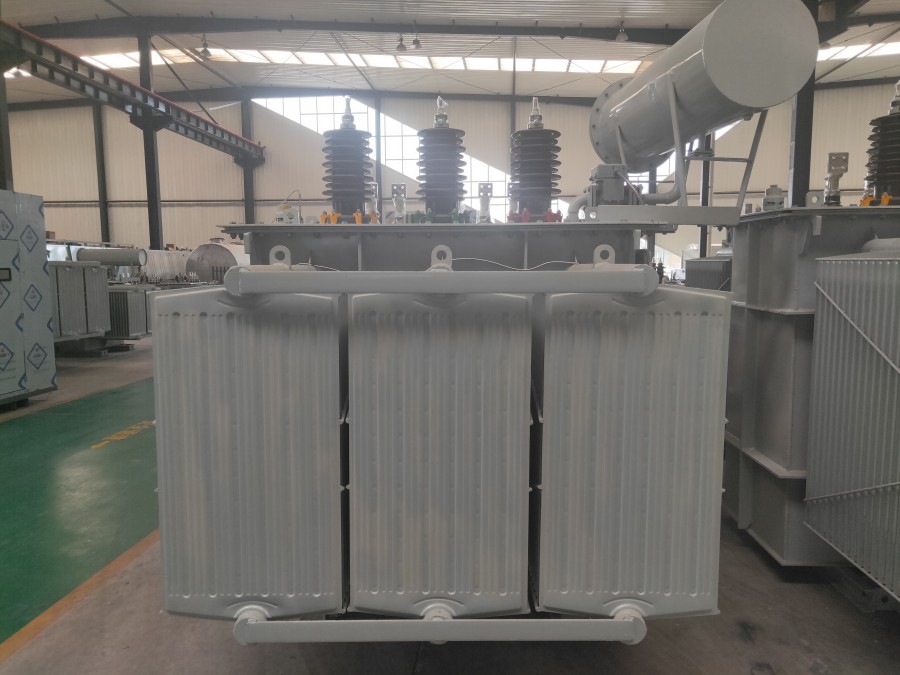
For a buyer, the practical meaning is simple: one tank, one foundation, one protection package and one set of bushings can serve three voltage levels at once. That is why the three winding transformer is standard equipment in substations, industrial plants and renewable energy collector systems where two distribution voltages plus an auxiliary supply must be delivered from a single point.
The trade-off is technical rather than commercial. Impedance between winding pairs must be designed deliberately, and if the tertiary is a delta stabilising winding it must still be rated to withstand short-circuit duty. A supplier who simply shrinks the tertiary rating to save copper without checking short-circuit withstand is not giving you a bargain — that is a design risk.
Most three winding transformers use a core-type construction with concentric windings. The tertiary is often placed nearest the core because it carries the lowest voltage, with the medium voltage and high voltage windings arranged outward. Wound-core designs, including three-dimensional magnetic path wound core structures, reduce no-load loss and are increasingly popular for distribution duty. Insulation levels, winding material, clamping and drying process determine both the loss figures and the service life, so these are the areas where a low quote usually hides its savings.
Oil-immersed three winding transformers, for example the S11, S13, S20 and S22 families, use transformer oil for insulation and cooling and are normally installed outdoors or in dedicated oil-containing rooms. They are the economic choice for larger ratings and higher voltage classes. Dry-type units such as the SCB10, SCB13, SCB14 and SCB18 series use cast resin insulation, contain no oil, and suit indoor installation in buildings, metro systems, hospitals and commercial complexes where fire safety and minimal maintenance matter. Amorphous alloy options such as the SH15 range can further reduce no-load loss where the transformer runs lightly loaded for long periods.
In distribution and industrial applications the three winding transformer is most often specified at 35 kV and below, with capacities from roughly 30 kVA up to 6300 kVA, though larger and higher voltage units are built to order. Common vector groups include YNyn0d11 and YNd11d11, where the delta tertiary provides the harmonic path. Frequency, cooling method, temperature rise, altitude and ambient temperature all affect the final design and must be stated in the enquiry, not assumed.
Four factors dominate: conductor material and weight, core material and loss grade, oil volume and tank construction, and the testing scope. Copper windings, grain-oriented silicon steel or amorphous core, low loss guarantees and full type testing all cost money — and all reduce your operating cost over twenty years. A quote that is dramatically cheaper almost always relaxes one of these. Comparing only the purchase price of a three winding transformer, without comparing guaranteed losses, tertiary rating and test scope, is the single most common way buyers lose money.
At minimum, insist on routine tests for every unit, plus type test evidence for the design and any special tests agreed in the contract. The delivery package should include the operation manual, inspection report, test certificate and nameplate details, together with a traceable quality record. A manufacturer offering lifelong quality tracking gives you something a trader cannot: an identifiable design history if anything needs attention years later.
Runsheng Transformer Co., Ltd. manufactures S11, S13, S20 and S22 oil-immersed transformers, SCB10, SCB13, SCB14 and SCB18 dry-type transformers, SH15 amorphous alloy transformers, mining and rectifier transformers, plus 35 kV and below preassembled substations and high and low voltage switchgear. Units are built to national standards and shipped with manuals, inspection reports and test certificates, with oil-immersed transformers offered at factory-direct prices so that the trader margin stays in your project budget. For a three winding transformer requirement, sending your winding ratings, vector group and loss limits directly to the production team shortens the technical review cycle and usually produces a clearer, more comparable quotation.
If you are specifying a three winding transformer for a substation, industrial plant or renewable energy project, our engineering team can review your parameters and confirm the tertiary rating, impedance and loss guarantees before you commit. Phone: +86 13406394988, email: runsheng@7813transformer.com, WhatsApp: 008613508930968.

Runsheng Transformer Co., Ltd. is a professional manufacturer of power transformers, specializing in oil-immersed transformers (S20, S11, S13), SH15 amorphous alloy transformers, S13 series 10KV 3D magnetic path wound-core transformers, D10 single-phase wound-core transformers, as well as mining transformers, rectifier transformers, surge arrestor transformers, load-tap-changing transformers, and custom-engineered special transformers.
WhatsApp & Wechat

No. 6, Intersection of Mount Huangshan Road and Changjiang Road, Liaocheng High tech Industrial Development Zone, Shandong, China


