
When you have coordination challenges, turn to Runsheng Transformer for help
It's all about making things easy, building partnerships, and providing a point of contact.
A two winding transformer is the workhorse of every power system: one primary winding takes energy in, one secondary winding delivers it out at a different voltage, and both are wound around a single shared magnetic core. There is no third winding, no tertiary stabilizing winding and no auto-connection, which means the two circuits stay galvanically isolated. That isolation, plus a simple and robust topology, is exactly why this design dominates distribution networks, industrial plants, commercial buildings and renewable energy projects.
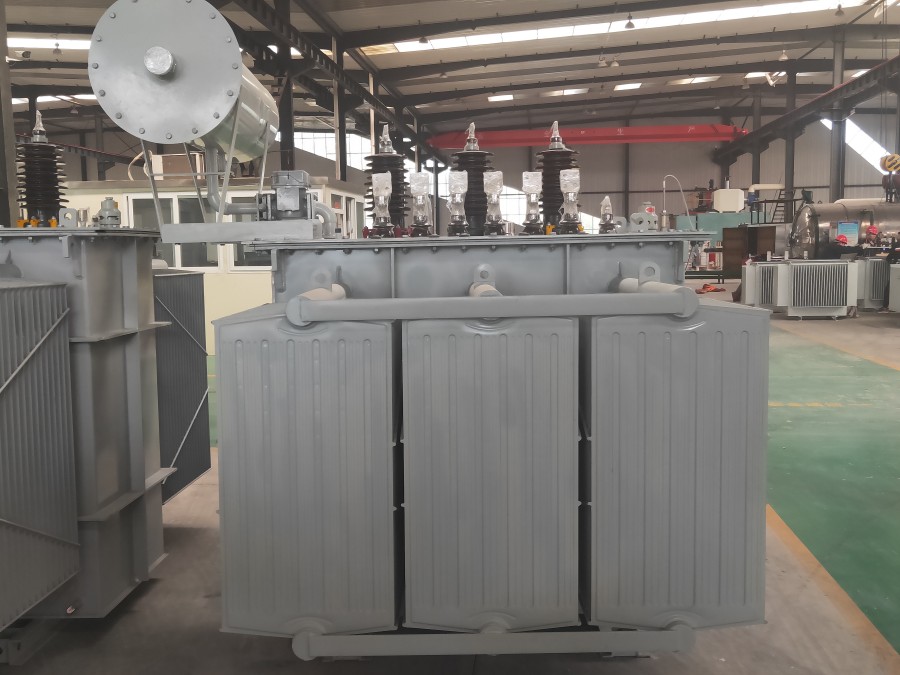
Because the concept is straightforward, the real engineering effort shifts to the details: core material, winding conductor, insulation structure, cooling method and loss level. Those five decisions separate a quiet, cool-running unit that pays for itself from an oversized paperweight that overheats at every summer peak.
The two families share the same working principle but behave very differently on site. Oil-immersed transformers use mineral oil for insulation and heat transfer, offer excellent overload capability and the lowest cost per kVA — the S11, S13, S20 and S22 series cover this ground, with each step representing a lower loss level. Dry-type transformers replace oil with cast resin or impregnated insulation, removing fire load and liquid containment; the SCB10, SCB13, SCB14 and SCB18 series are the usual references for indoor, high-rise and public-building duty.
A third option is the amorphous alloy core. Because the amorphous metal has extremely low hysteresis loss, units such as the SH15 and SCBH15 series deliver very low no-load loss, which pays back quickly on lightly loaded rural feeders, street lighting circuits and renewable energy collection systems. Wound-core and three-dimensional magnetic path designs (for example the S13 series 10 kV three-dimensional wound core transformer and the D10 single-phase wound core transformer) are chosen where low partial discharge, compact size and quiet operation are priorities.
Efficiency labels on a two winding transformer look similar on paper but differ sharply in operating cost. A unit with a higher loss grade can be 15% to 25% cheaper at purchase yet consume far more energy over its service life, and the gap widens under continuous load. When comparing quotations, always convert both loss figures into annual kWh at your actual load profile and multiply by your electricity tariff. A slightly higher purchase price for a low-loss design often pays back in two to four years, and the saving continues for the remaining two decades of service.
Runsheng Transformer Co., Ltd. manufactures oil-immersed transformers, dry-type transformers and amorphous alloy transformers from 30 to 6300 kVA, together with mining transformers, rectifier transformers and 35 kV and below preassembled substations. Buying from the source removes distributor markups, but the greater benefit is direct access to the engineers who set the winding, insulation and loss parameters — so the unit you receive matches the load you actually run.
A two winding transformer is simple in principle and unforgiving in execution. Match the voltage ratio and vector group to your network, choose oil-immersed or dry-type based on fire risk and location, treat loss figures as a lifetime cost rather than a datasheet line, and verify test certificates against the serial number on the nameplate. Do that, and a factory-direct purchase becomes a genuine saving instead of a gamble.
Contact: phone +86 13406394988 | e-mail runsheng@7813transformer.com | WhatsApp 008613508930968

Runsheng Transformer Co., Ltd. is a professional manufacturer of power transformers, specializing in oil-immersed transformers (S20, S11, S13), SH15 amorphous alloy transformers, S13 series 10KV 3D magnetic path wound-core transformers, D10 single-phase wound-core transformers, as well as mining transformers, rectifier transformers, surge arrestor transformers, load-tap-changing transformers, and custom-engineered special transformers.
WhatsApp & Wechat

No. 6, Intersection of Mount Huangshan Road and Changjiang Road, Liaocheng High tech Industrial Development Zone, Shandong, China


