
When you have coordination challenges, turn to Runsheng Transformer for help
It's all about making things easy, building partnerships, and providing a point of contact.
A step up transformer is a static electrical device that raises voltage from a lower level at its primary winding to a higher level at its secondary winding. It contains no moving parts and operates on the principle of electromagnetic induction: when alternating current flows through the primary winding, it creates a changing magnetic flux in the laminated core, and that flux induces a higher voltage in the secondary winding, which has more turns.
The relationship is straightforward. The voltage ratio equals the turns ratio, so if the secondary has ten times as many turns as the primary, the output voltage is roughly ten times the input voltage. Because power must be conserved in an ideal transformer, current falls in the same proportion as voltage rises. That is the whole reason a step up transformer exists: it lets a system move the same amount of power (measured in kVA or MVA) at a much lower current.
Line losses follow the square of current, which means doubling current quadruples the heat dissipated in conductors. For a given power transfer, raising voltage by a factor of ten cuts current to one tenth and reduces resistive losses to one hundredth. This is why generating stations, wind farms and solar plants all use a step up transformer before feeding into a transmission or distribution network, and why the device is often called a generator step up transformer (GSU) in power plant design.
Oil-immersed transformers such as the S11, S13, S20 and S22 series use insulating oil for both cooling and dielectric strength. They handle higher capacities efficiently, tolerate outdoor installation and offer strong overload capability, which makes them the default choice for substations and industrial plants.
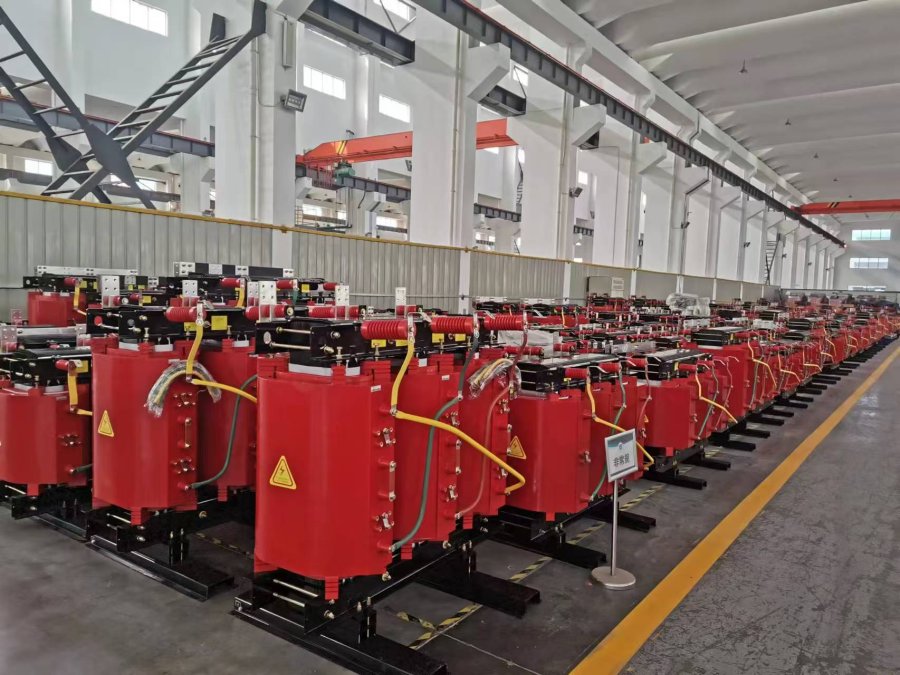
Dry-type transformers such as the SCB10, SCB13, SCB14 and SCB18 series use epoxy cast-resin windings. They contain no flammable oil, produce no leakage risk and are ideal for indoor rooms, commercial buildings, hospitals and metro projects where fire safety and maintenance access are priorities.
Amorphous alloy transformers in the SH15 and SCBH15 series use amorphous metal cores with very low no-load loss, an attractive option for utilities and operators running lightly loaded circuits for long hours.
Beyond the standard families, purpose-built units include the mining transformer, rectifier transformer and renewable energy transformer, each engineered for harsh environments, harmonic-rich loads or variable output from solar and wind assets. A 35kV transformer or compact substation package often combines the transformer with high low voltage switchgear in a single preassembled unit.
Choose oil-immersed when capacity is high, installation is outdoors, and cost per kVA matters most. Choose dry-type when the transformer sits inside an occupied building, when fire codes restrict flammable liquids, or when routine oil testing and leak inspection are impractical. If energy efficiency is the dominant concern and load factors are low, an amorphous alloy design usually pays back fastest.
The largest cost components are copper or aluminum conductor, grain-oriented silicon steel for the core, insulation materials, the tap changer, the tank or enclosure, and factory testing. Market prices for copper and electrical steel move constantly, which is why a quotation is usually valid for a limited period. Buying factory direct removes distributor margin and, more importantly, keeps the specification conversation between your engineers and the people who actually build the unit.
A qualified supplier should be able to show the full product range, not a single catalog page. Runsheng Transformer Co., Ltd., for example, produces S22, S20, S11 and S13 oil-immersed transformers, SCB13, SCB14 and SCB18 dry-type transformers, SH15 amorphous alloy transformers, 35kV and below preassembled substations, European-style and American-style compact substations, and high low voltage switchgear, along with mining transformers, rectifier transformers and custom-designed special transformers. Units are supplied with manuals, inspection reports, test certificates and lifelong quality tracking, and the company maintains inventory for factory-direct delivery.
Can a step down transformer be used as a step up transformer? Electrically the windings can often be reversed, but insulation levels, tap configuration and cooling are designed for a specific direction. Check with the manufacturer before reversing service.
How long does delivery take? Standard inventory items ship quickly, while custom units depend on capacity, materials and testing schedules. Confirm lead time in the purchase contract.
Is a load tap changing transformer necessary? Only if the supply voltage fluctuates enough to affect connected equipment. Many distribution applications are well served by off-circuit tapping.
Understanding the basics of a step up transformer, from turns ratio and vector group to cooling class and loss figures, gives you the vocabulary to compare quotations fairly and avoid the hidden costs that appear years later. Specify accurately, demand test documentation, and source from a manufacturer who will still answer the phone after commissioning.
Contact us for specifications, drawings or a quotation: phone +86 13406394988, e-mail runsheng@7813transformer.com, WhatsApp 008613508930968.

Runsheng Transformer Co., Ltd. is a professional manufacturer of power transformers, specializing in oil-immersed transformers (S20, S11, S13), SH15 amorphous alloy transformers, S13 series 10KV 3D magnetic path wound-core transformers, D10 single-phase wound-core transformers, as well as mining transformers, rectifier transformers, surge arrestor transformers, load-tap-changing transformers, and custom-engineered special transformers.
WhatsApp & Wechat

No. 6, Intersection of Mount Huangshan Road and Changjiang Road, Liaocheng High tech Industrial Development Zone, Shandong, China


