
When you have coordination challenges, turn to Runsheng Transformer for help
It's all about making things easy, building partnerships, and providing a point of contact.
An oil immersed power transformer is a static electrical device that transfers electrical energy between circuits through electromagnetic induction, with its core and windings fully submerged in insulating oil inside a sealed steel tank. The oil performs two jobs at the same time: it insulates the live parts and it carries heat away from the windings to the tank walls, radiators or cooling tubes. Because of that dual role, oil immersed units dominate medium and large capacity applications, from 30 kVA distribution units up to 6300 kVA and beyond, in utility networks, industrial plants, mining sites and renewable energy projects.
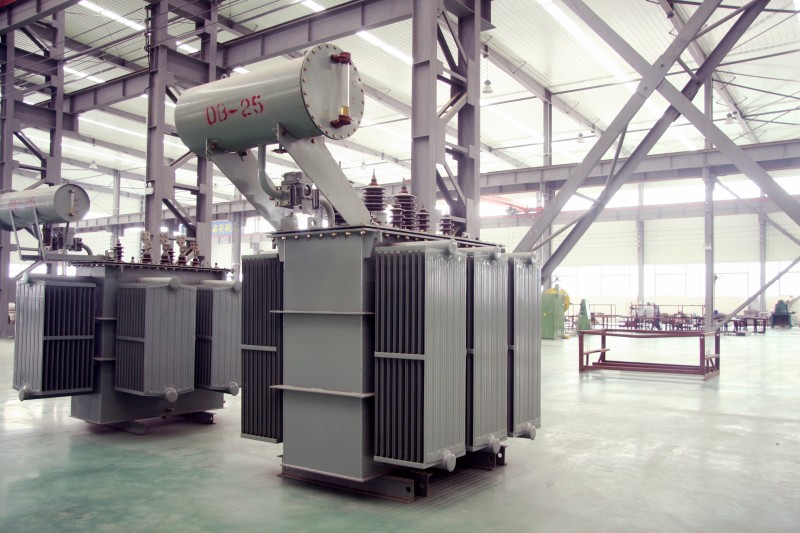
Compared with dry-type designs, an oil immersed power transformer usually offers a lower cost per kVA, stronger overload capability, better heat dissipation and quieter operation. That is why it remains the standard choice for outdoor distribution duty and for step-up or step-down service at substations.
The principle is straightforward: alternating current in the primary winding creates a changing magnetic flux in the laminated or wound core, and that flux induces a voltage in the secondary winding. The ratio of turns determines the voltage ratio, while the core material determines how much energy is wasted as no-load loss.
What makes the oil immersed design special is thermal management. Heated oil rises naturally through the windings, flows into the radiators, cools against ambient air and sinks back to the bottom of the tank. This convection loop, known as ONAN cooling, is completely passive. For higher ratings, fans or oil pumps are added to create ONAF or OFAF cooling, which can raise the usable capacity of the same tank by 20 to 30 percent.
Model designations are not marketing labels; they indicate loss levels and energy efficiency. The S11 oil immersed transformer is a classic low-loss design widely used in distribution networks. The S13 oil immersed transformer cuts no-load loss further, the S20 series moves to an even higher efficiency class, and the S22 series represents the current top tier of energy-saving distribution transformers. Amorphous alloy versions such as SH15 offer extremely low no-load loss for lightly loaded or rural feeders.
Dry-type counterparts, including the SCB10, SCB13, SCB14 and SCB18 families, serve indoor, fire-sensitive locations such as commercial buildings and metro stations. In practice, the choice between oil immersed and dry-type usually comes down to installation environment, fire code and budget.
These units are the workhorses behind urban and rural distribution networks, industrial plants, water treatment facilities, railway traction substations, mining transformers, rectifier transformers for electrolysis and metal smelting, and renewable energy transformer stations for wind and solar farms. Many modern projects also combine a compact substation or European-style and American-style preassembled substation with the transformer, high-voltage switchgear and low-voltage switchgear in a single packaged solution.
Two quotes for the same 1000 kVA, 10 kV transformer can differ by 30 percent or more. The gap almost always comes from materials rather than workmanship:
This is where buying factory-direct matters. As a power transformer manufacturer, Runsheng Transformer Co., Ltd. produces S22, S20, S11 and S13 oil-immersed transformers, SCB13, SCB14 and SCB18 dry-type transformers, SH15 amorphous alloy transformers and 35KV and below preassembled substation equipment, and keeps a comprehensive inventory with assured quality and factory-direct prices.
Correct installation is as important as the transformer itself. Units should sit on a level foundation with adequate clearance for cooling, be protected by surge arresters on the high-voltage side, and be commissioned with insulation resistance and oil dielectric tests. After that, a simple maintenance routine of oil level checks, breather silica gel replacement and periodic oil analysis will keep an oil immersed power transformer running reliably for 25 to 30 years.
When you buy from a manufacturer that supplies manuals, inspection reports, test certificates and lifelong quality tracking with every unit, you are not only buying hardware; you are buying a documented performance guarantee that protects your project from start to finish.
Runsheng Transformer Co., Ltd. follows a quality policy of customer satisfaction first, combining innovation, pragmatism, integrity and efficiency to deliver tailored transformer solutions. If you need a quotation, technical selection support or a custom-designed special transformer, contact us at phone: +86 13406394988, e-mail: runsheng@7813transformer.com, or WhatsApp: 008613508930968.

Runsheng Transformer Co., Ltd. is a professional manufacturer of power transformers, specializing in oil-immersed transformers (S20, S11, S13), SH15 amorphous alloy transformers, S13 series 10KV 3D magnetic path wound-core transformers, D10 single-phase wound-core transformers, as well as mining transformers, rectifier transformers, surge arrestor transformers, load-tap-changing transformers, and custom-engineered special transformers.
WhatsApp & Wechat

No. 6, Intersection of Mount Huangshan Road and Changjiang Road, Liaocheng High tech Industrial Development Zone, Shandong, China


