
When you have coordination challenges, turn to Runsheng Transformer for help
It's all about making things easy, building partnerships, and providing a point of contact.
An oil immersed power transformer is a transformer whose core and windings are mounted inside a sealed steel tank filled with insulating oil. The oil does two jobs at the same time: it insulates live parts and current-carrying conductors, and it carries heat away from the coils by convection to the radiator fins or corrugated tank walls, where that heat escapes into the surrounding air. Because this cooling loop is simple, reliable and inexpensive to build, the oil immersed power transformer remains the default choice for 10kV, 20kV and 35kV distribution networks and for most industrial power supply projects.
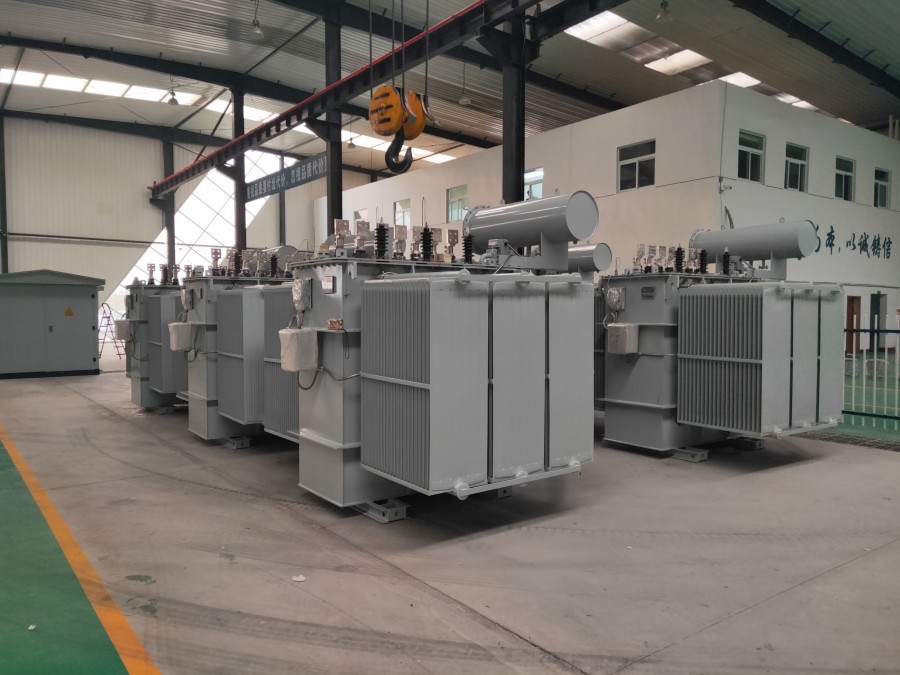
Compared with dry-type units, an oil immersed power transformer usually delivers lower no-load and load losses at the same capacity, stronger short-time overload capability, and a lower cost per kVA. The trade-off is that it needs a dedicated installation room or fire separation plus periodic oil testing, so the two technologies often appear side by side in one project, each doing the job it does best.
Every unit is built around four building blocks. Understanding them makes specification and price comparison far easier.
Because the oil both insulates and cools, an oil immersed power transformer is compact for its rating and can be built up to very large capacities. In distribution service, the 30-6300 kVA band covers most demand.
Model codes tell you the loss level and the construction. Generally speaking, the higher the number, the lower the energy loss and the more efficient the design.
A quotation is only comparable when the technical data matches. Check these items line by line.
Mount the unit on a level foundation with adequate clearance for airflow and inspection. Check oil level, silica gel in the breather and all gaskets before energising. During operation, monitor oil temperature, oil level and gas relay alarms, and take an oil sample at least once a year. A well-maintained oil immersed power transformer commonly serves 20 to 30 years, and most failures trace back to moisture ingress, loose connections or long-term overload rather than to the core and coils themselves.
Runsheng Transformer Co., Ltd. manufactures S22, S20, S11 and S13 oil-immersed transformers, SCB13, SCB14 and SCB18 dry-type transformers, SH15 amorphous alloy transformers, 10kV three-dimensional magnetic path wound core units, and special designs such as mining transformers and rectifier transformers. The company also supplies 35kV and below preassembled substation equipment, including European-style and American-style compact substations and high/low-voltage switchgear. Because units ship direct from the factory, buyers get assured quality at factory-direct prices, with manuals, inspection reports, test certificates and lifelong quality tracking included. Its quality policy, customer satisfaction is Runsheng's mission, keeps the focus on matching each project with the right transformer rather than selling the most expensive one.
For specifications, drawings or a quotation on any oil immersed power transformer or dry-type unit, contact the sales team directly: phone +86 13406394988, e-mail runsheng@7813transformer.com, WhatsApp 008613508930968.

Runsheng Transformer Co., Ltd. is a professional manufacturer of power transformers, specializing in oil-immersed transformers (S20, S11, S13), SH15 amorphous alloy transformers, S13 series 10KV 3D magnetic path wound-core transformers, D10 single-phase wound-core transformers, as well as mining transformers, rectifier transformers, surge arrestor transformers, load-tap-changing transformers, and custom-engineered special transformers.
WhatsApp & Wechat

No. 6, Intersection of Mount Huangshan Road and Changjiang Road, Liaocheng High tech Industrial Development Zone, Shandong, China


