
When you have coordination challenges, turn to Runsheng Transformer for help
It's all about making things easy, building partnerships, and providing a point of contact.
If you are sourcing equipment for a utility feeder, an industrial plant, a renewable energy project, or a mining site, the term oil immersed distribution transformer will appear in almost every specification you receive. It is the most widely installed type of distribution equipment in the world, and the reasons are straightforward: proven insulation performance, strong short-time overload capability, long service life, and a lower cost per kVA than most alternatives. This overview explains what an oil immersed distribution transformer actually is, how it is built, which models appear most often in quotations, and how to buy one at a fair factory-direct price.
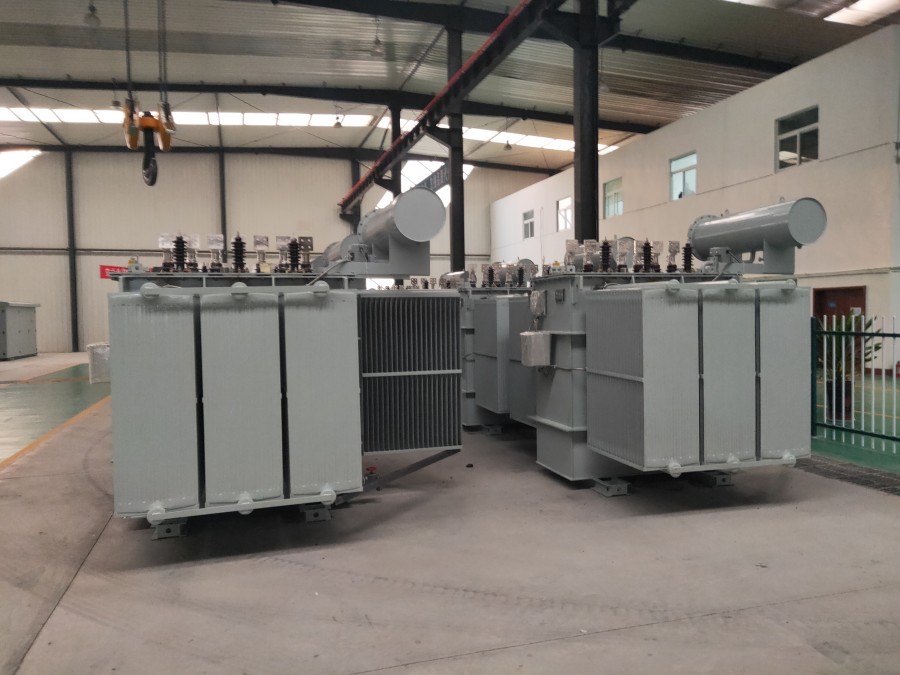
An oil immersed distribution transformer is a static electrical device that steps medium voltage down to the level used by end consumers. Typical primary voltages are 6 kV, 10 kV, and 35 kV, while secondary output is usually 400 V or 415 V for three-phase systems, or 240 V for single-phase systems. It has no moving parts; energy transfer happens through magnetic induction between two windings wound around a common magnetic core.
The insulating oil inside the tank performs two critical jobs at once. First, it insulates the windings and other live parts, allowing compact clearances at medium voltage. Second, it transfers heat away from the core and windings to the tank walls and radiators, where it dissipates into the surrounding air. This dual function is why oil immersed designs handle continuous loading and short-term overloads so reliably.
The magnetic core is normally made from grain-oriented cold-rolled silicon steel laminations, cut and stacked to minimize eddy current and hysteresis losses. More advanced designs use a wound core structure, such as the 10 kV three-dimensional magnetic path wound core used in the S13 series, which shortens the magnetic path and reduces no-load loss. Amorphous alloy cores, used in the SH15 and SCBH15 series, go further by cutting no-load loss dramatically because the alloy has very low hysteresis loss.
Windings are usually copper or aluminium, formed as layer, foil, or continuous disc types depending on voltage class and capacity. Copper windings offer lower resistance and better short-circuit strength; aluminium windings reduce weight and cost. Buyers should always confirm the conductor material in writing, because it directly affects load loss and long-term thermal behaviour.
The tank, conservator, bushings, tap changer, breather, and protective devices complete the assembly. Hermetically sealed tanks eliminate oil contact with air and reduce maintenance, while conservator-type tanks with a silica gel breather are still common in larger units. Buchholz relays and pressure relief devices protect against internal faults.
The main alternative is the dry type transformer. SCB10, SCB13, SCB14, and SCB18 dry type transformers use epoxy resin or similar solid insulation and contain no oil, which makes them a natural fit for indoor locations with strict fire safety requirements, such as shopping centres, hospitals, subways, and high-rise buildings.
Typical applications include utility pole-mounted and pad-mounted distribution, industrial plants, commercial buildings, water treatment facilities, railway traction auxiliaries, solar and wind renewable energy transformer stations, mine site power distribution, and rectifier duty for electrolysis or DC drives. They are also the core component inside European-style and American-style compact substations and other preassembled substation equipment.
An oil immersed distribution transformer with proper routine care commonly operates for 20 to 30 years. Practical maintenance includes checking oil level and oil temperature, replacing or regenerating silica gel in the breather, inspecting gaskets and bushings for leaks or contamination, and performing periodic dissolved gas analysis and oil dielectric strength testing. Keeping load within nameplate rating and ensuring adequate ventilation around the tank will noticeably extend service life.
Runsheng Transformer Co., Ltd. manufactures S22, S20, S11, and S13 oil-immersed transformers, SCB13, SCB14, and SCB18 dry-type transformers, SH15 amorphous alloy transformers, mining transformers, rectifier transformers, and custom-designed special transformers, along with 35 kV and below preassembled substation equipment. As a transformer manufacturer serving domestic and overseas buyers, the company maintains comprehensive inventory so that products ship with manuals, inspection reports, test certificates, and lifelong quality tracking.
For buyers who need a fast quotation or technical confirmation, contact: phone +86 13406394988, e-mail runsheng@7813transformer.com, or WhatsApp 008613508930968.

Runsheng Transformer Co., Ltd. is a professional manufacturer of power transformers, specializing in oil-immersed transformers (S20, S11, S13), SH15 amorphous alloy transformers, S13 series 10KV 3D magnetic path wound-core transformers, D10 single-phase wound-core transformers, as well as mining transformers, rectifier transformers, surge arrestor transformers, load-tap-changing transformers, and custom-engineered special transformers.
WhatsApp & Wechat

No. 6, Intersection of Mount Huangshan Road and Changjiang Road, Liaocheng High tech Industrial Development Zone, Shandong, China


