
When you have coordination challenges, turn to Runsheng Transformer for help
It's all about making things easy, building partnerships, and providing a point of contact.
Choosing the right oil immersed distribution transformer can save a project a significant amount of money across its service life, or cost it dearly if the efficiency grade, specification or supplier is wrong. This overview explains what these transformers are, how they work, which models dominate the market, and what experienced buyers verify before placing an order, so first-time and repeat purchasers alike can approach procurement with confidence.
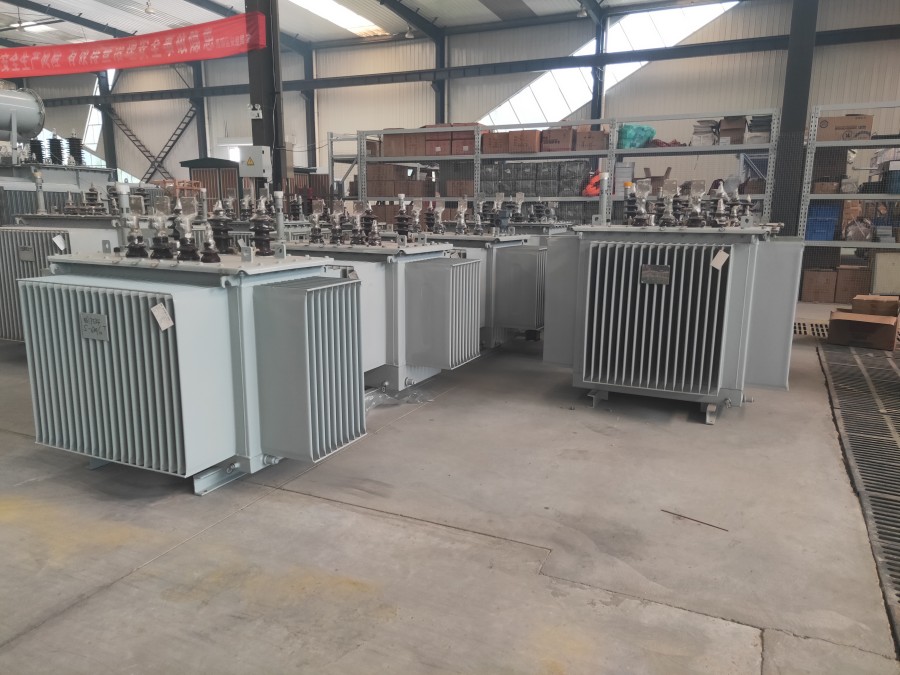
An oil immersed distribution transformer is a static electrical device that steps a medium-voltage supply down to the low voltage used by end consumers, or feeds a local distribution network. Its core and windings are fully submerged in insulating oil inside a steel tank. The oil performs two duties at once: it insulates the windings and it carries heat away from the core and coils toward the tank walls, where that heat dissipates into the surrounding air.
Because one medium provides both dielectric strength and cooling, the design is compact, mechanically robust and economical in the 30 kVA to 6300 kVA range that dominates public distribution networks, industrial plants, commercial buildings and renewable energy projects. Typical primary voltages are 10 kV, 20 kV and 35 kV, with a secondary voltage of 0.4 kV for most distribution duties.
A conventional unit consists of a laminated magnetic core, copper or aluminium windings, an insulated tank, insulating oil, bushings, and a set of protective accessories. Off-circuit tap changers allow the turns ratio to be adjusted at commissioning to compensate for supply voltage variations, usually in steps of plus or minus 5 percent or two steps of 2.5 percent.
In the widely used Chinese naming convention, the letter S indicates a three-phase oil-immersed unit, and the number indicates the loss performance level. Higher numbers mean lower no-load loss and better energy efficiency, which usually translates into a higher purchase price but a lower electricity bill over the equipment's life.
Specialised variants are also common: mining transformers for dusty and hazardous sites, rectifier transformers for electrolysis and smelting, capacity-regulating transformers for seasonal loads, and custom special transformers designed around a specific duty cycle.
Oil immersed distribution transformers are the default choice for outdoor and well-ventilated indoor installations: urban and rural distribution substations, factories, construction sites, water treatment plants, hospitals, railway traction auxiliary supplies, solar and wind farms, and packaged substations. They are usually preferred over dry-type units where the environment permits oil, because they offer a lower cost per kVA and better overload tolerance. Dry-type transformers remain the better answer for high-rise buildings, tunnels and other locations where fire safety rules restrict flammable liquid.
Buying from a manufacturer rather than through several layers of trading companies usually removes mark-up and shortens the technical communication chain, since design questions go straight to the engineers who build the unit. Runsheng Transformer Co., Ltd. produces S11, S13, S20 and S22 oil-immersed transformers, SCB10, SCB13, SCB14 and SCB18 dry-type transformers, SH15 and SCBH15 amorphous alloy transformers, mining and rectifier transformers, plus European-style and American-style compact substations and high and low voltage switchgear. Units are manufactured to national standards and shipped with manuals, inspection reports and test certificates, supported by lifelong quality tracking.
Correct installation protects the investment as much as good specification does. Mount the transformer on a level, well-ventilated foundation with adequate clearance for cooling and inspection, check oil level and tightness before energising, verify earthing of the tank and neutral, and confirm the tap changer position matches the site voltage. During operation, periodic checks of oil level, oil temperature, bushing condition and seal integrity will catch most developing faults early. For sealed corrugated-tank units, maintenance is minimal; for conservator types, silica gel colour and oil dielectric strength should be monitored regularly.
A sound purchase starts with a clear load study, an honest efficiency target and a supplier willing to put test data behind every claim. Whether the requirement is a single 100 kVA unit for a plant extension or a batch of 1250 kVA and 2500 kVA transformers for a distribution programme, matching model, losses, impedance and protection to the actual duty will deliver the lowest total cost of ownership rather than merely the lowest quotation.
For technical selection support, drawings, quotations or custom special transformer enquiries, contact Runsheng Transformer Co., Ltd. at phone: +86 13406394988, e-mail: runsheng@7813transformer.com, or WhatsApp: 008613508930968.

Runsheng Transformer Co., Ltd. is a professional manufacturer of power transformers, specializing in oil-immersed transformers (S20, S11, S13), SH15 amorphous alloy transformers, S13 series 10KV 3D magnetic path wound-core transformers, D10 single-phase wound-core transformers, as well as mining transformers, rectifier transformers, surge arrestor transformers, load-tap-changing transformers, and custom-engineered special transformers.
WhatsApp & Wechat

No. 6, Intersection of Mount Huangshan Road and Changjiang Road, Liaocheng High tech Industrial Development Zone, Shandong, China


