
When you have coordination challenges, turn to Runsheng Transformer for help
It's all about making things easy, building partnerships, and providing a point of contact.
ONAF stands for Oil Natural Air Forced. It is a cooling class designation for oil-immersed transformers, and it describes exactly how heat is removed from the core and windings: the oil circulates by natural convection, while fans force air across the radiator banks to increase the rate at which that heat is rejected to the atmosphere. An ONAF transformer is therefore not a different machine from a conventional oil-immersed unit — it is the same active part, specified and tested with a forced-air cooling stage that unlocks additional capacity.
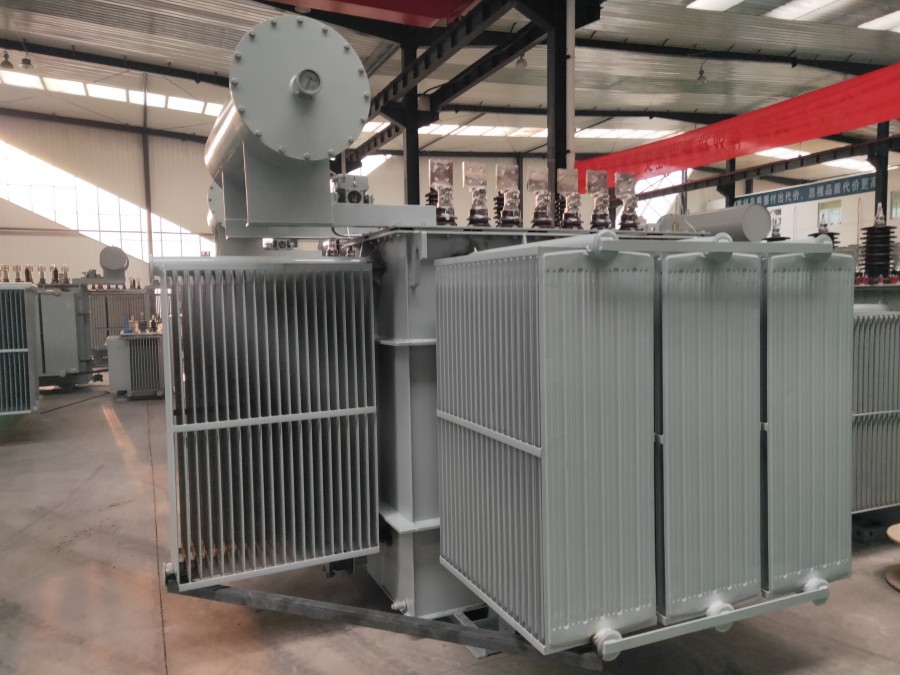
Cooling class designations follow IEC 60076-2 and IEEE C57.12.00 conventions, where each letter identifies the coolant inside the tank and the circulation method outside it. Reading the nameplate correctly is the first step in any serious procurement exercise, because the cooling class determines the guaranteed rating, the permissible temperature rise, the noise level, and the auxiliary load of the unit.
Because the oil circulation remains natural, an ONAF transformer has no oil pumps, no forced-oil pipework, and no risk of pump cavitation or flow-related static electrification. That simplicity is one reason the design remains the default choice for medium and large distribution and sub-transmission duty.
Most ONAF transformer specifications are written as dual ratings, for example 40/50 MVA or 100 percent / 125 percent of base power. In the ONAN stage the unit operates fan-free and quiet; when the fans start, the permissible load rises to the ONAF rating. This gives the buyer two important advantages: an emergency overload capability without exceeding the temperature limits defined in IEC 60076-2, and the ability to defer a costly upgrade when load grows gradually. It also supports N-1 operation in substations where a single transformer must carry the load of a failed companion unit for a limited period.
Temperature rise limits are normally quoted at the standard reference ambient conditions — a maximum of 40 degrees Celsius, a daily average of 30 degrees Celsius, and a yearly average of 20 degrees Celsius — with top-oil rise generally limited to 60 K and average winding rise to 65 K, depending on the insulation system and the standard invoked. Any site with sustained ambient temperatures above 40 degrees Celsius requires a derating calculation, not an assumption.
The cooling class suits almost every application where a naturally cooled unit would otherwise be oversized. Typical installations include urban and rural distribution substations, industrial plants with fluctuating load profiles, mining and metallurgical sites, wind and solar collection substations, data centres and commercial complexes, and 35 kV class compact substations where footprint is tightly constrained. In renewable energy projects, the ONAF rating is often what allows a single unit to ride through the short-term peaks of a variable generation profile.
An ONAF transformer costs more than an equivalent ONAN unit because of the radiators, fans, control cabinet and additional testing, but it is usually far cheaper than buying the next frame size up. The practical economics come from three areas: lower capital cost per MVA of usable capacity, capitalised loss evaluation over a 20 to 30 year service life, and the ability to delay reinforcement of the substation. Buyers who evaluate only the purchase price, and ignore no-load loss, load loss and fan energy, routinely pay more over the asset life.
Working directly with a manufacturer rather than through layers of trading companies typically removes intermediate margins and shortens the technical clarification loop. Runsheng Transformer Co., Ltd. produces ONAF-capable oil-immersed transformers across the S11, S13, S20 and S22 series, along with dry-type and amorphous alloy units, and ships each set with manuals, inspection reports, test certificates and lifelong quality tracking.
An ONAF transformer is one of the most cost-effective tools available for matching installed capacity to a load that is not constant. Specified correctly — with both ratings stated, losses evaluated honestly, and the auxiliary system properly designed — it delivers years of service with minimal moving parts and predictable maintenance. Contact us for specification support or a factory-direct quotation: phone +86 13406394988, e-mail runsheng@7813transformer.com, WhatsApp 008613508930968.

Runsheng Transformer Co., Ltd. is a professional manufacturer of power transformers, specializing in oil-immersed transformers (S20, S11, S13), SH15 amorphous alloy transformers, S13 series 10KV 3D magnetic path wound-core transformers, D10 single-phase wound-core transformers, as well as mining transformers, rectifier transformers, surge arrestor transformers, load-tap-changing transformers, and custom-engineered special transformers.
WhatsApp & Wechat

No. 6, Intersection of Mount Huangshan Road and Changjiang Road, Liaocheng High tech Industrial Development Zone, Shandong, China


