
When you have coordination challenges, turn to Runsheng Transformer for help
It's all about making things easy, building partnerships, and providing a point of contact.
An oil immersed distribution transformer is a static electrical device that steps medium-voltage power down to the level used by factories, commercial buildings, farms and residential communities. Its iron core and windings are fully immersed in insulating oil inside a sealed steel tank. The oil does two jobs at the same time: it insulates the live parts and it carries heat away from the windings to the tank walls and radiators. Because liquid cooling is so efficient, an oil immersed distribution transformer can carry heavy continuous loads, tolerate dusty, humid and corrosive environments, and typically costs less per kVA than an air-cooled unit of the same rating.
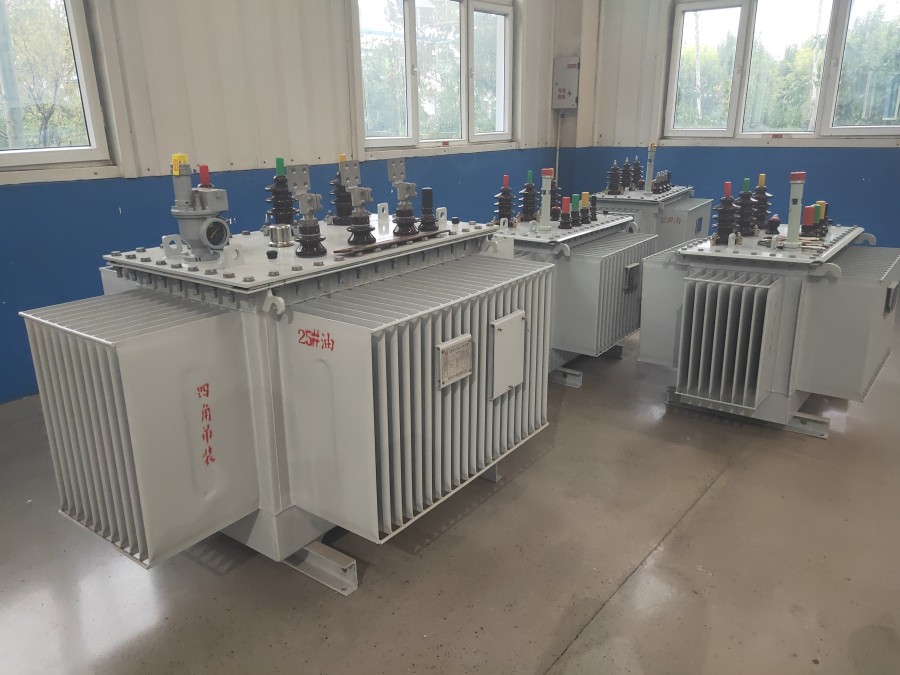
For anyone procuring distribution equipment — plant engineers, EPC contractors, project owners — understanding the basic structure, model naming and key parameters is the fastest way to avoid overpaying and to avoid buying a unit that does not match the load profile.
When alternating current flows through the primary winding, it creates an alternating magnetic flux in the laminated iron core. That flux induces a lower voltage in the secondary winding according to the turns ratio. Everything lives inside an oil-filled tank, which is why the unit is quiet, compact and highly reliable in service.
The letter and number combination on the nameplate tells you the design generation and the efficiency level. Newer generations generally deliver lower no-load loss and lower load loss, which directly reduces your electricity bill over a 20 to 30 year service life.
Standard ratings span 30 to 6300 kVA, with 10kV and 35kV classes covering the majority of distribution projects. Dry-type equivalents such as the SCB10, SCB13, SCB14 and SCB18 series are used where oil is not permitted indoors.
Price differences between quotes for the same specification often come from the sales chain, not the copper. Buyers who purchase directly from the production line get verified material lists, factory test data and a shorter delivery cycle. Runsheng Transformer Co., Ltd. manufactures S11, S13, S20 and S22 oil-immersed transformers, SCB13, SCB14 and SCB18 dry-type transformers, SH15 and SCBH15 amorphous alloy transformers, plus mining transformers, rectifier transformers, lightning arrester transformers, capacity-regulating transformers and custom-designed special transformers. Every unit ships with a manual, inspection report, test certificate and lifelong quality tracking.
When comparing offers, always ask for: the full set of type test and routine test reports, the actual loss values rather than catalogue minimums, the tank finish specification, the oil grade and origin, and the warranty terms including on-site support.
What service life can I expect? A properly loaded and maintained oil immersed distribution transformer typically serves 20 to 30 years, with oil and bushing maintenance being the main variables.
Can it be installed indoors? Only in a dedicated, ventilated and fire-rated chamber; otherwise select a dry-type unit.
How long is delivery? Standard ratings from a stocked manufacturer usually ship far faster than custom-built units; confirm the lead time in writing.
Whether you need a single 630 kVA unit for a plant expansion or a full 35kV preassembled substation package, buying straight from the factory keeps quality traceable and your budget intact. Phone: +86 13406394988 | E-mail: runsheng@7813transformer.com | WhatsApp: 008613508930968.

Runsheng Transformer Co., Ltd. is a professional manufacturer of power transformers, specializing in oil-immersed transformers (S20, S11, S13), SH15 amorphous alloy transformers, S13 series 10KV 3D magnetic path wound-core transformers, D10 single-phase wound-core transformers, as well as mining transformers, rectifier transformers, surge arrestor transformers, load-tap-changing transformers, and custom-engineered special transformers.
WhatsApp & Wechat

No. 6, Intersection of Mount Huangshan Road and Changjiang Road, Liaocheng High tech Industrial Development Zone, Shandong, China


