
When you have coordination challenges, turn to Runsheng Transformer for help
It's all about making things easy, building partnerships, and providing a point of contact.
A dry cast resin transformer is a power distribution transformer whose high-voltage and low-voltage windings are encapsulated in epoxy resin under vacuum, so the unit contains no insulating oil whatsoever. Instead of relying on oil for dielectric strength and cooling, the coils are cast into solid resin cylinders that insulate the winding, protect it mechanically and dissipate heat through air circulation around the coil surface. That single design decision is what creates the two advantages buyers care about most: no fire risk from flammable liquid and almost no routine maintenance.
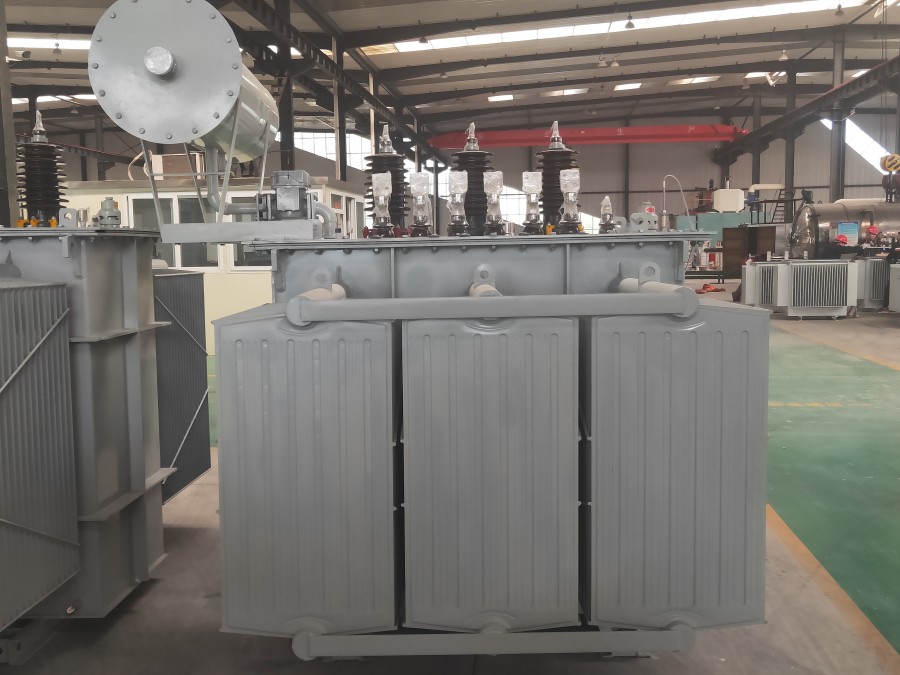
Cast resin units are built to the same electrical logic as any distribution transformer — they step 10kV or 35kV down to 400V for a plant, building or substation — but they are deployed wherever oil is unwelcome: inside buildings, in basements, on rooftops, in tunnels, hospitals, data centres and shopping malls.
The manufacturing sequence is what separates a reliable dry cast resin transformer from a cheap imitation, so it is worth knowing before you sign a purchase order.
A genuine dry cast resin transformer should show partial discharge levels held to roughly 10 pC or below on routine test. If a supplier cannot produce that record, the casting process is not under control.
Most projects specify one of the standard SCB or SGB families. The model number is not decoration — it signals the loss level and energy performance of the design.
Typical ratings run from 30 kVA to 2500 kVA with 10kV or 35kV primary voltage, insulation class F or H, temperature rise around 100K for air-natural (AN) cooling and 125K with forced-air (AF) cooling, and protection degrees from IP00 open design through IP20 and IP23 enclosures. Ratings up to 6300 kVA and custom special transformers are available for mining, rectifier and renewable-energy duty.
The dry cast resin transformer has become the default choice in several sectors because its limitations are rarely a problem there and its safety is a real benefit.
Buyers usually ask for a cast resin transformer price first and specifications second, which is the wrong order. Cost is determined by rating, winding material, loss class, copper market price, enclosure rating and whether the unit is standard or customised. A 1000 kVA SCB14 with aluminium windings and a 1000 kVA SCB18 with copper windings are not comparable products, so any quote that does not state the model, loss level and winding material is not a real quote.
The biggest avoidable cost is not the manufacturing cost at all — it is the distribution chain. Trading companies, agents and resellers add margin without adding engineering value. Purchasing from the manufacturer removes that layer.
Runsheng Transformer Co., Ltd. manufactures oil-immersed and dry-type transformer ranges including SCB10, SCB13, SCB14, SCB18 and SGB10 cast resin units, alongside S11, S13, S20 and S22 oil-immersed transformers, SH15 amorphous alloy transformers, mining and rectifier transformers, plus 35kV and below preassembled substations, compact substations and high and low voltage switchgear. Buying from the production floor means factory-direct pricing, documented testing and lifelong quality tracking rather than a markup for a middleman's phone call.
A properly installed dry cast resin transformer is one of the least demanding assets in a substation. Practical care is limited to keeping the coil surfaces and cooling ducts dust-free, checking terminal torque annually, monitoring the temperature controller and watching for unusual noise or vibration. In clean, well-ventilated rooms, a quality unit commonly serves 20 to 30 years.
If you are comparing quotations for an upcoming project, request the full technical data sheet, the loss values and the routine test report before comparing prices — then compare total cost of ownership. Runsheng Transformer Co., Ltd. can supply complete documentation with every unit.
Phone: +86 13406394988 | E-mail: runsheng@7813transformer.com | WhatsApp: 008613508930968

Runsheng Transformer Co., Ltd. is a professional manufacturer of power transformers, specializing in oil-immersed transformers (S20, S11, S13), SH15 amorphous alloy transformers, S13 series 10KV 3D magnetic path wound-core transformers, D10 single-phase wound-core transformers, as well as mining transformers, rectifier transformers, surge arrestor transformers, load-tap-changing transformers, and custom-engineered special transformers.
WhatsApp & Wechat

No. 6, Intersection of Mount Huangshan Road and Changjiang Road, Liaocheng High tech Industrial Development Zone, Shandong, China


