
When you have coordination challenges, turn to Runsheng Transformer for help
It's all about making things easy, building partnerships, and providing a point of contact.
The letters in ODAF stand for Oil Directed, Air Forced. It is a cooling class designation used for liquid-immersed power transformers, and it tells you two things at once: the insulating oil is pumped and directed through the winding ducts rather than allowed to circulate naturally, and the heat that reaches the radiators or coolers is removed by fans moving air across the cooling surfaces. An ODAF transformer is therefore a unit whose rated capacity depends on a cooling system that is actively driven on both the oil side and the air side.
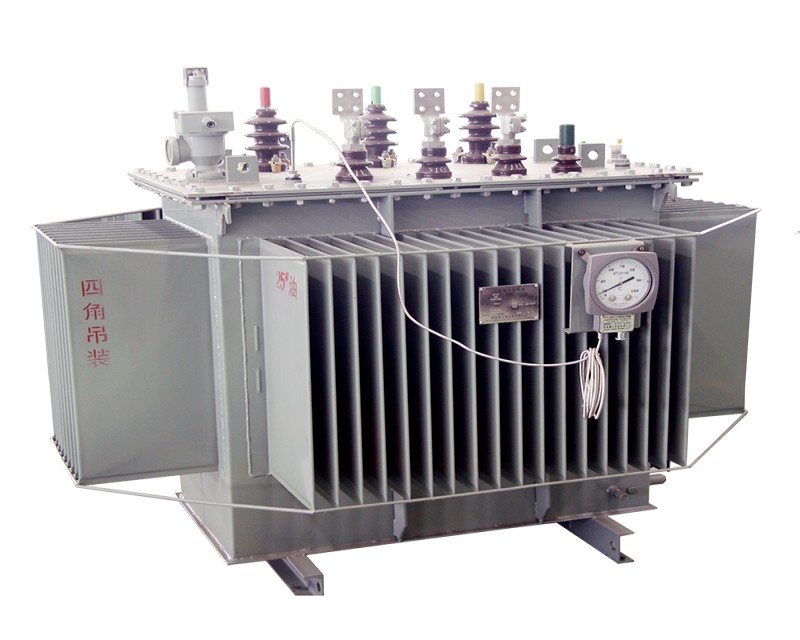
In practice, cooling class letters matter as much as the nameplate kVA. The same core and coil assembly can be rated at different outputs depending on which pumps and fans are running, which is why utilities and industrial buyers use ODAF to squeeze more capacity out of a transformer than natural cooling alone could ever deliver.
In a conventional oil-immersed transformer, hot oil rises by natural convection from the windings into the radiators and returns cooled. In an ODAF transformer, oil pumps draw cooled oil from the bottom of the tank and direct it through inlet guides and washers into axial ducts inside the windings. Because the oil is forced through defined channels, it travels faster and stays in closer contact with the conductor insulation, so heat leaves the winding more efficiently. On the outside, fans blow air across the radiator banks or cooler assemblies to strip the heat from the returning oil.
Two design details separate good ODAF cooling from ordinary forced cooling:
Buyers comparing quotations frequently see several cooling designations on a nameplate. Understanding the difference avoids specifying more cooling than the load profile justifies:
Simply put, ODAF sits above ONAN and ONAF in thermal capability. Where a natural-cooled unit may be limited to its base rating, an ODAF transformer can be specified with two or three cooling stages, for example base rating with pumps and fans off, an intermediate rating with fans running, and a full rating with both pumps and fans running. That staged approach is what allows operators to carry short-term overloads, such as during a parallel-unit outage or a summer peak, without exceeding winding hot-spot limits.
ODAF cooling is most common on large power transformers where losses per unit of volume are high: generator step-up units, grid intertie and transmission transformers, large industrial rectifier and smelter transformers, and renewable energy step-up applications such as offshore or large onshore wind and solar collector substations. Mining transformers and other heavy-duty industrial units also use forced cooling when load cycles are aggressive but space is limited.
When you specify an ODAF transformer, ask the manufacturer for these items in writing:
ODAF systems are reliable, but they add rotating equipment to the maintenance schedule. Check oil flow indicators and differential pressure regularly, inspect fan blades and pump couplings for wear, verify that automatic stage switching responds correctly to temperature, and confirm that valves are left in the correct position after any cooler servicing. Oil quality matters more in ODAF units because higher velocity and pressure make contamination and moisture more damaging: dissolved gas analysis and oil tests should follow a fixed interval.
Because ODAF transformers are engineered to order, the manufacturer's design capability and documentation discipline matter as much as the price. Runsheng Transformer Co., Ltd. builds oil-immersed and dry-type transformers together with custom-designed special transformers, compact substations and high/low-voltage switchgear, supplying oil-immersed units at factory-direct prices with manuals, inspection reports, test certificates and lifelong quality tracking. If your project needs a cooling class defined around a real load profile rather than a catalogue number, a technical review before the order is the cheapest step you will take.
Contact us for specifications, drawings or a quotation: phone +86 13406394988, e-mail runsheng@7813transformer.com, WhatsApp 008613508930968.

Runsheng Transformer Co., Ltd. is a professional manufacturer of power transformers, specializing in oil-immersed transformers (S20, S11, S13), SH15 amorphous alloy transformers, S13 series 10KV 3D magnetic path wound-core transformers, D10 single-phase wound-core transformers, as well as mining transformers, rectifier transformers, surge arrestor transformers, load-tap-changing transformers, and custom-engineered special transformers.
WhatsApp & Wechat

No. 6, Intersection of Mount Huangshan Road and Changjiang Road, Liaocheng High tech Industrial Development Zone, Shandong, China


