
When you have coordination challenges, turn to Runsheng Transformer for help
It's all about making things easy, building partnerships, and providing a point of contact.
A high voltage power transformer is a static piece of electrical equipment that transfers energy between two or more circuits by electromagnetic induction, stepping voltage up for transmission or down for distribution and utilisation. In distribution and industrial practice, the term generally covers units rated from 30 kVA to 6300 kVA at primary voltage classes of 6 kV, 10 kV and 35 kV, with a low-voltage output of 0.4 kV or another application-specific level. Because the magnetic circuit has no moving parts, a correctly specified and maintained high voltage power transformer can operate reliably for decades — provided the core, windings, insulation system and cooling method match the actual load profile.
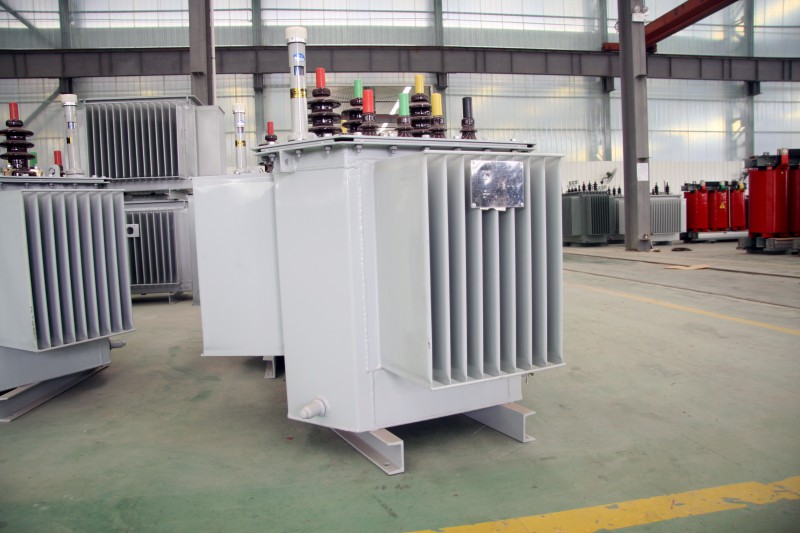
This overview explains the basic principle, the main product families, the parameters that drive price and performance, and the practical checks that help buyers avoid expensive mistakes.
The working principle is simple in theory and demanding in execution. Alternating current in the primary winding creates an alternating magnetic flux in the laminated steel core; that flux links the secondary winding and induces a voltage there. The voltage ratio follows the turns ratio between the two windings, while the rated capacity, impedance and temperature rise determine how much power the unit can carry continuously.
Three construction details separate an average transformer from a good one:
Both families are widely used, and neither is universally better — the decision depends on location, fire safety requirements, load duty and budget.
Two quotations for the same apparent rating are rarely identical. Always compare these values:
High voltage power transformers sit at the interface between the utility network and the user's installation. Common duties include urban and rural distribution networks, preassembled and compact substations, mining transformers for heavy cyclic loads, rectifier transformers for metallurgy and electrolysis, lightning arrester transformers for test laboratories, capacity-regulating transformers, and renewable energy transformer packages for solar and wind farms. Each of these applications changes the specification: mining duty demands high short-circuit strength, rectifiers demand harmonic-tolerant windings, and renewable projects demand low losses and wide load-range efficiency.
Buyers often ask why two 1000 kVA, 10/0.4 kV quotations can differ by 30% or more. The answer is almost always inside the tank:
Copper and steel prices on the world market move constantly, so a realistic transformer price should be quoted against a defined material basis and a defined loss level, not just a capacity figure.
For any high voltage power transformer, request the routine test report (ratio, polarity, resistance, no-load loss, load loss, impedance, dielectric tests), a type test report where applicable, a certificate of conformity to GB 1094 / GB/T 6451 or GB/T 10228 and IEC 60076, the installation and operation manual, and a packing list. Reputable manufacturers such as Runsheng Transformer Co., Ltd. supply manuals, inspection reports and test certificates with every unit, together with lifelong quality tracking so that performance data can be traced back years after commissioning.
Before placing an order, confirm the load calculation and future expansion margin, the actual site conditions (indoor or outdoor, ambient temperature, altitude, humidity, corrosive atmosphere), the vector group and tap requirement, the loss level you are willing to pay for, the certification and test package, the delivery schedule, and the after-sales and spare parts support offered by the manufacturer. Buying factory-direct removes distributor margins and shortens the communication chain when a special design is needed — custom special transformers, mining or rectifier duty units, and non-standard voltage combinations are all normal business for an experienced source factory.
Runsheng Transformer Co., Ltd. manufactures oil-immersed, dry-type, amorphous alloy and special transformers from 30 kVA to 6300 kVA, along with 35 kV and below preassembled substations, compact substations and high/low-voltage switchgear, offering oil-immersed transformers at factory-direct prices with a full documentation package.
Phone: +86 13406394988 | E-mail: runsheng@7813transformer.com | WhatsApp: 008613508930968

Runsheng Transformer Co., Ltd. is a professional manufacturer of power transformers, specializing in oil-immersed transformers (S20, S11, S13), SH15 amorphous alloy transformers, S13 series 10KV 3D magnetic path wound-core transformers, D10 single-phase wound-core transformers, as well as mining transformers, rectifier transformers, surge arrestor transformers, load-tap-changing transformers, and custom-engineered special transformers.
WhatsApp & Wechat

No. 6, Intersection of Mount Huangshan Road and Changjiang Road, Liaocheng High tech Industrial Development Zone, Shandong, China


