
When you have coordination challenges, turn to Runsheng Transformer for help
It's all about making things easy, building partnerships, and providing a point of contact.
An oil immersed distribution transformer is a static device that steps medium-voltage power — usually 10 kV or 35 kV — down to the 400/230 V level that factories, commercial buildings and residential networks actually use. Its core and windings sit inside a steel tank completely covered by insulating oil, and that oil performs two duties at once: it insulates the live parts and it carries heat away from the windings to the tank walls and radiators.
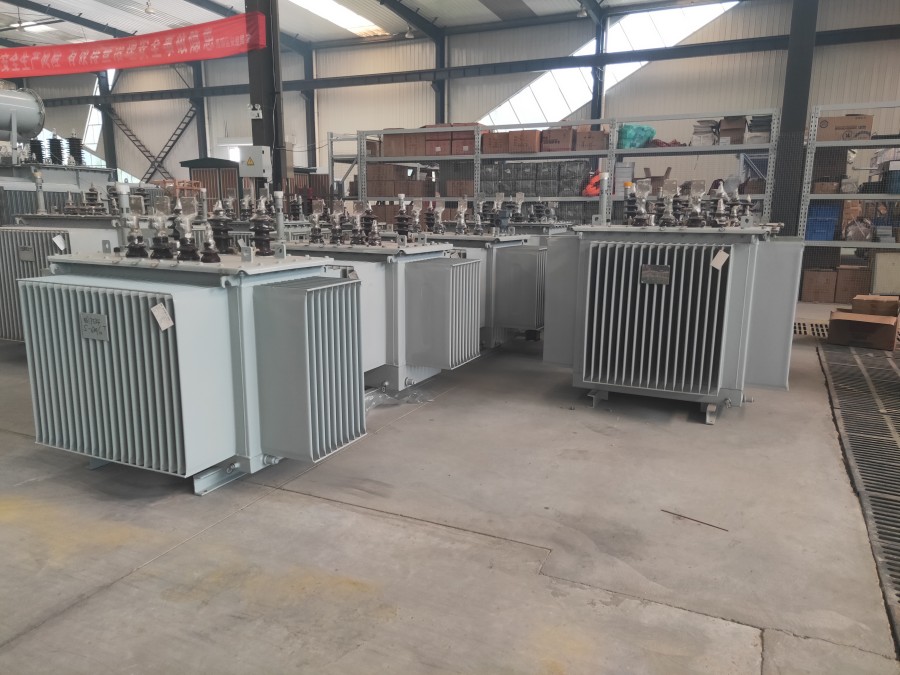
Oil cooling is efficient, mechanically simple and inexpensive to build, which is why the oil immersed distribution transformer remains the most widely installed type in the world. Dry-type units win on fire safety inside buildings, but for outdoor substations, pole-mounted installations and general industrial distribution, the liquid-filled design delivers far more capacity per unit of cost.
Knowing the main components makes a specification sheet much easier to read:
Three-phase units from about 30 kVA to 6300 kVA dominate distribution duty. In the Chinese market the series number broadly follows loss performance: S11 is the long-established baseline, S13 lowers no-load loss further, and S20 and S22 push efficiency higher again. A higher series number generally means a higher purchase price and a lower running cost, so the right choice depends on how many hours a year the unit will be loaded.
Mechanically there are two families. The conservator, or breathing, type uses an oil conservator with a desiccant breather; the sealed type uses corrugated tank walls so the oil never contacts air. Sealed units need less routine maintenance, while conservator units are easier to inspect and top up.
By voltage, the 10 kV class covers the majority of distribution projects, while 35 kV units and special-duty designs — mining transformers, rectifier transformers, capacity-regulating transformers and other custom special transformers — serve heavier or unusual industrial loads.
Losses are the hidden cost of any distribution transformer. No-load loss is consumed 24 hours a day, whether the plant is running or not, so on a lightly loaded unit it can outweigh the price difference between two series within a few years. Load loss rises with the square of the current, so it matters most in continuously loaded installations.
The practical rule is simple: the longer the operating hours and the higher the average load factor, the more it pays to buy the lower-loss series. For short-term projects or standby duty, the cheaper baseline model is often the more rational purchase.
Mount the transformer on a level foundation with adequate ventilation and clearance for cooling. Check oil level and tightness before energizing, verify the tap changer position against the actual supply voltage, and confirm earthing of the tank and neutral. After commissioning, a yearly routine is usually enough: oil level and colour, breather silica gel condition, gasket tightness, terminal torque, and periodic oil dielectric tests. Keeping records makes early fault detection far easier.
Buying from the production line rather than through resellers removes a layer of margin and, more importantly, keeps the specification transparent. Manufacturers such as Runsheng Transformer Co., Ltd. build the S11, S13, S20 and S22 oil-immersed series alongside SCB dry-type and SH15 amorphous alloy units, hold stock for fast delivery and supply each unit with a manual, inspection report, test certificate and lifelong quality tracking.
When you request a quotation for an oil immersed distribution transformer, send the capacity, voltage ratio, vector group, loss requirement, installation environment and any site-specific standard, then compare offers on the full technical package rather than on price alone.
Contact: phone +86 13406394988 | e-mail runsheng@7813transformer.com | WhatsApp 008613508930968

Runsheng Transformer Co., Ltd. is a professional manufacturer of power transformers, specializing in oil-immersed transformers (S20, S11, S13), SH15 amorphous alloy transformers, S13 series 10KV 3D magnetic path wound-core transformers, D10 single-phase wound-core transformers, as well as mining transformers, rectifier transformers, surge arrestor transformers, load-tap-changing transformers, and custom-engineered special transformers.
WhatsApp & Wechat

No. 6, Intersection of Mount Huangshan Road and Changjiang Road, Liaocheng High tech Industrial Development Zone, Shandong, China


