
When you have coordination challenges, turn to Runsheng Transformer for help
It's all about making things easy, building partnerships, and providing a point of contact.
ONAN stands for Oil Natural Air Natural — a cooling designation defined in IEC 60076 and mirrored in GB 1094 and IEEE C57.12.00. It describes a liquid-immersed transformer in which the insulating oil circulates by natural convection inside the tank, and the heat carried by the oil is dissipated to ambient air by natural convection and radiation across the radiator surfaces. There are no pumps and no fans. The four letters are a complete professional term: they define the cooling medium and the circulation method for each stage of the heat path, so the term "ONAN transformer" should never be shortened, split or rearranged.
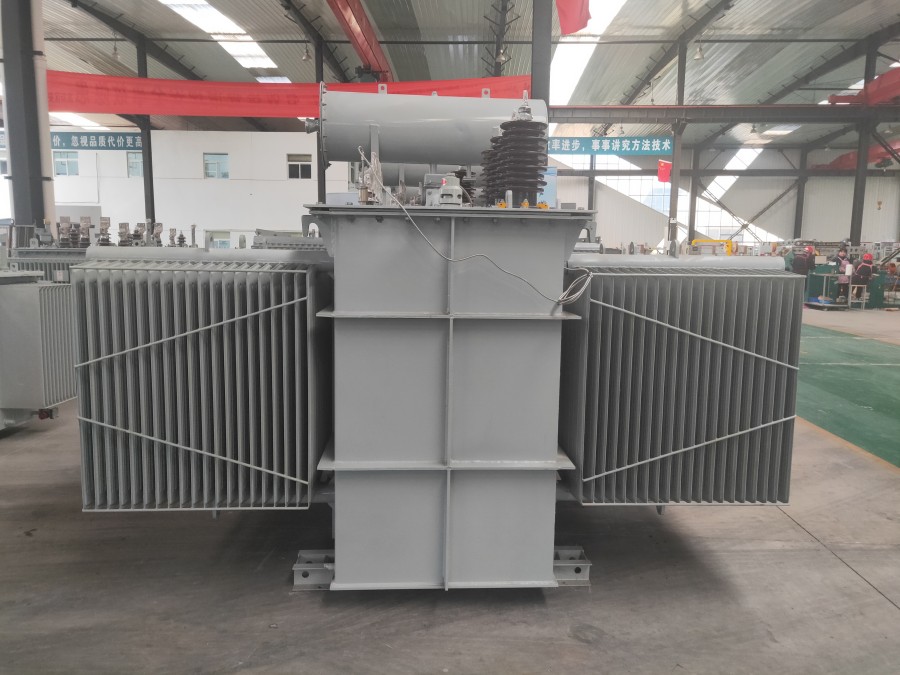
Because the cooling loop has no moving parts, ONAN transformers are the simplest, quietest and most maintenance-friendly class of distribution transformer — which is why the overwhelming majority of 30–6300 kVA oil-immersed distribution units in service worldwide are ONAN rated.
Heat generated in the core and windings transfers to the surrounding oil. Warm oil becomes less dense and rises toward the tank top, while cooler oil descends along the tank walls and radiator panels. This thermosiphon effect produces a continuous, self-regulating circulation. Radiators — corrugated walls, tubes or panel banks — multiply the effective heat-transfer surface, and paint finish, panel spacing and free airflow around the unit all influence the final temperature rise.
Typical ONAN limits are 65 K top-oil temperature rise and 78 K winding average rise by the resistance method, with hot-spot limits around 98 °C for standard insulation systems. When load or ambient conditions exceed natural cooling capability, manufacturers add fans (ONAF) or oil pumps (OFAF/ODAF) — but that is a different cooling class and must be declared on the nameplate.
These units are the workhorses of utility distribution feeders, industrial plants, commercial buildings, hospitals and data facilities, rural electrification, mining and renewable energy collection systems. Common oil-immersed product families built to the ONAN principle include the S11, S13, S20 and S22 series, with the higher-number designs targeting progressively lower losses, and amorphous alloy units such as SH15 aimed at very low no-load loss for lightly loaded or intermittent duty.
Two ONAN transformers with the same kVA rating can differ by 30% or more in price. The gap usually comes from winding material (copper versus aluminium), core grade and loss class, radiator area, tank construction, accessory quality, tap changer type and the extent of routine and type testing. A quote that looks cheap on day one can cost far more in no-load losses over twenty years of continuous energisation, which is why professional buyers always compare price and guaranteed losses together.
A reliable manufacturer publishes its loss tables, insulation levels and radiator calculations instead of hiding them behind a generic datasheet. Runsheng Transformer Co., Ltd., a power transformer manufacturer based in China, produces S22, S20, S11 and S13 oil-immersed transformers, SCB13, SCB14 and SCB18 dry-type transformers, SH15 amorphous alloy transformers, mining and rectifier transformers, and 35 kV preassembled compact substations. Every oil-immersed transformer is supplied factory-direct with a manual, inspection report, test certificate and lifelong quality tracking, so the specification on paper is the specification delivered.
Can an ONAN transformer be installed indoors? Yes, provided the room is ventilated to remove the heat load; the rating is based on free air circulation, so enclosed spaces require a calculated ventilation opening.
How often should the oil be tested? A dielectric strength and moisture check every one to two years, plus dissolved gas analysis for critical units.
Is a higher efficiency class worth the extra cost? For continuously energised distribution units, the reduced no-load loss usually repays the price difference within a few years of operation.
Can a custom ratio or special duty be built? Yes — mining transformers, rectifier transformers, lightning arrester duty units and capacity-regulating designs are routinely engineered to order.
Treat the ONAN transformer as a long-term energy asset rather than a commodity. Specify the losses, demand the test reports, verify the winding material and radiator sizing, and compare total cost of ownership. Working with an experienced factory-direct supplier keeps both the price and the technical support under your control.
Contact: phone +86 13406394988 | e-mail runsheng@7813transformer.com | WhatsApp 008613508930968.

Runsheng Transformer Co., Ltd. is a professional manufacturer of power transformers, specializing in oil-immersed transformers (S20, S11, S13), SH15 amorphous alloy transformers, S13 series 10KV 3D magnetic path wound-core transformers, D10 single-phase wound-core transformers, as well as mining transformers, rectifier transformers, surge arrestor transformers, load-tap-changing transformers, and custom-engineered special transformers.
WhatsApp & Wechat

No. 6, Intersection of Mount Huangshan Road and Changjiang Road, Liaocheng High tech Industrial Development Zone, Shandong, China


