
When you have coordination challenges, turn to Runsheng Transformer for help
It's all about making things easy, building partnerships, and providing a point of contact.
A three winding transformer is a power transformer built with three electrically independent windings on a single magnetic core. One winding is the primary, connected to the supply voltage; the other two are secondary windings, each delivering a different voltage level. Instead of stepping power down in two separate stages through two transformers, one unit handles the whole conversion. For readers new to the topic, the simplest way to picture it is a single core with three sets of copper conductors, magnetically coupled but electrically isolated, each sized for its own voltage and current.
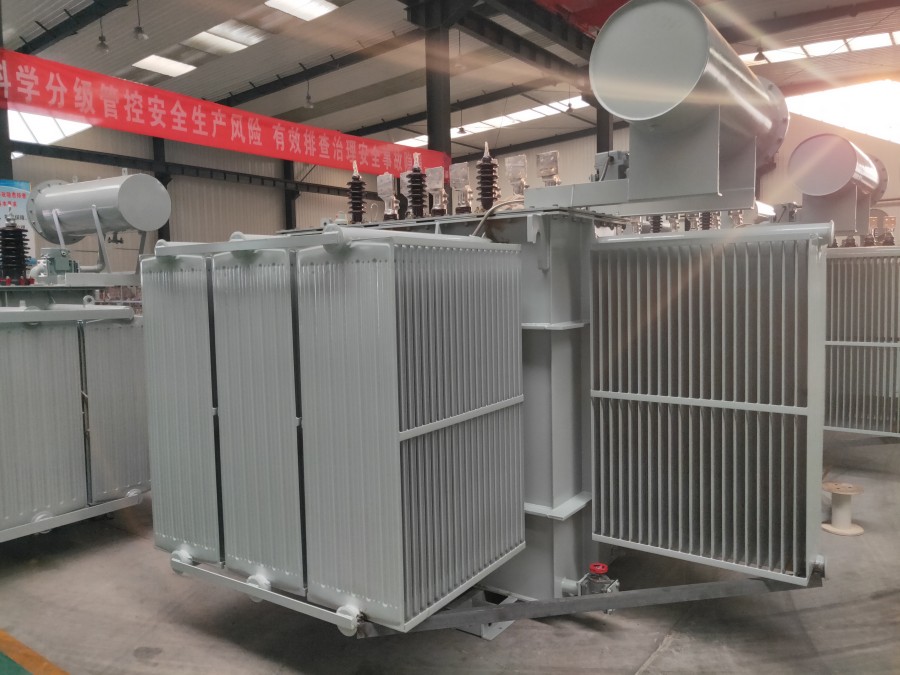
The third winding is often called the tertiary winding. It may carry real load, such as feeding a 10 kV auxiliary bus from a 35 kV incoming line, or it may serve a technical purpose: providing a path for zero-sequence current, supplying reactive compensation equipment, or reducing harmonic distortion. That dual role is what makes the three winding transformer more interesting than a simple two-winding unit, and it is also where most specification mistakes happen.
Procurement teams usually compare the three winding transformer against two cascaded two-winding units. The single-unit approach wins on several counts:
The trade-off is that the unit is heavier, the fault level on the common core is higher, and a failure affects both secondary systems at once. That is why redundancy planning still matters in critical installations.
In the distribution range, most units are oil-immersed, with windings immersed in insulating oil and cooled by natural oil circulation, designated ONAN, sometimes upgraded to ONAF with fans for higher capacity. Dry-type designs use cast-resin or resin-encapsulated windings and are preferred where oil is unacceptable: inside buildings, in tunnels, near water treatment areas, or in fire-sensitive process plants. In the Runsheng Transformer Co., Ltd. catalogue, these map to the S11, S13, S20 and S22 oil-immersed families and the SCB10, SCB13, SCB14 and SCB18 dry-type families, with ratings commonly spanning 30–6300 kVA.
The winding arrangement is described by a vector group symbol. Common configurations include YNyn0d11, where the high-voltage winding is star-connected with a neutral brought out, the low-voltage winding is also star-connected with a neutral, and the tertiary is delta-connected to stabilise the zero-sequence path. A delta tertiary is especially useful where unbalanced single-phase loads or third-harmonic currents are expected. The choice of vector group is not cosmetic; it governs neutral availability, earth-fault protection behaviour and paralleling conditions.
An accurate datasheet is the difference between a machine that runs quietly for thirty years and one that trips protection every summer. Confirm each of the following in writing:
Real installations tend to cluster into a few patterns. Step-down substations on 35 kV and below use a three winding transformer to supply two distribution voltage levels, typically 10 kV and 0.4 kV, from one incoming feeder. Renewable energy projects use them to combine collection voltage and station service supply. Industrial plants with mixed motor and process loads use the tertiary to feed capacitor banks or harmonic filters. Mining and heavy process sites favour robust oil-immersed units with reinforced insulation and dust-resistant cooling. In all these cases the same rule applies: size the unit for the load profile, not for the nameplate habit.
Price gaps between quotations for the same nominal rating are usually not random. They come from specific differences that buyers can verify:
Comparing on total cost of ownership, not on purchase price alone, resolves most of these questions. Loss evaluation over a ten-year horizon often outweighs a small initial discount.
Documentation is the cheapest insurance in transformer procurement. A serious manufacturer supplies an operation manual, factory inspection report, routine test certificate and a traceable quality record covering the life of the unit. As a transformer manufacturer serving both standard distribution demand and custom projects, Runsheng Transformer Co., Ltd. ships every unit with this documentation package and offers factory-direct pricing on oil-immersed and dry-type designs, including special types such as mining, rectifier and capacity-regulating transformers, together with preassembled and compact substations and high/low-voltage switchgear for complete station packages.
For specification support, drawings or a quotation on a three winding transformer, contact the team directly: phone +86 13406394988, e-mail runsheng@7813transformer.com, WhatsApp 008613508930968.

Runsheng Transformer Co., Ltd. is a professional manufacturer of power transformers, specializing in oil-immersed transformers (S20, S11, S13), SH15 amorphous alloy transformers, S13 series 10KV 3D magnetic path wound-core transformers, D10 single-phase wound-core transformers, as well as mining transformers, rectifier transformers, surge arrestor transformers, load-tap-changing transformers, and custom-engineered special transformers.
WhatsApp & Wechat

No. 6, Intersection of Mount Huangshan Road and Changjiang Road, Liaocheng High tech Industrial Development Zone, Shandong, China


