
Buying a two winding transformer? How to Avoid Overpaying, Spot Quality, and Buy Factory-Direct

What Exactly Is a two winding transformer?

A two winding transformer is the most common transformer design in power systems: it has one primary winding connected to the source and one secondary winding connected to the load, both wound on a shared magnetic core. Energy moves from primary to secondary purely through electromagnetic induction, so the two circuits stay electrically isolated while voltage and current are stepped up or down. That galvanic isolation is the reason a two winding transformer is preferred over an autotransformer wherever safety, fault containment or grounding flexibility matters.
Buying a two winding transformer? How to Avoid Overpaying, Spot Quality, and Buy Factory-Direct

How a two winding transformer Works: The Basics in Plain Language

When alternating current flows in the primary winding, it creates an alternating magnetic flux in the core. The flux links the secondary winding and induces an electromotive force in it. Because each turn of either winding links almost the same flux, the voltage per turn is essentially equal on both sides, giving the classic relationship V1/V2 = N1/N2. Current behaves inversely, so I1/I2 is approximately N2/N1. Losses — no-load (core) loss and load (copper) loss — mean the output is always slightly below the input, which is why efficiency and loss levels are the first things an experienced buyer checks.

Typical Construction of a two winding transformer

  • Magnetic core: cold-rolled grain-oriented silicon steel laminations, usually with step-lap mitered joints to reduce no-load loss and noise.
  • Windings: copper or aluminium conductors in layer, foil or disc form, insulated with oil-impregnated paper or epoxy resin.
  • Insulation system and dielectric clearances designed to the rated insulation level, covering lightning impulse and power-frequency withstand.
  • Tap changer: off-circuit tap links, typically plus or minus 2 by 2.5 percent, or an on-load tap changer for voltage regulation under load.
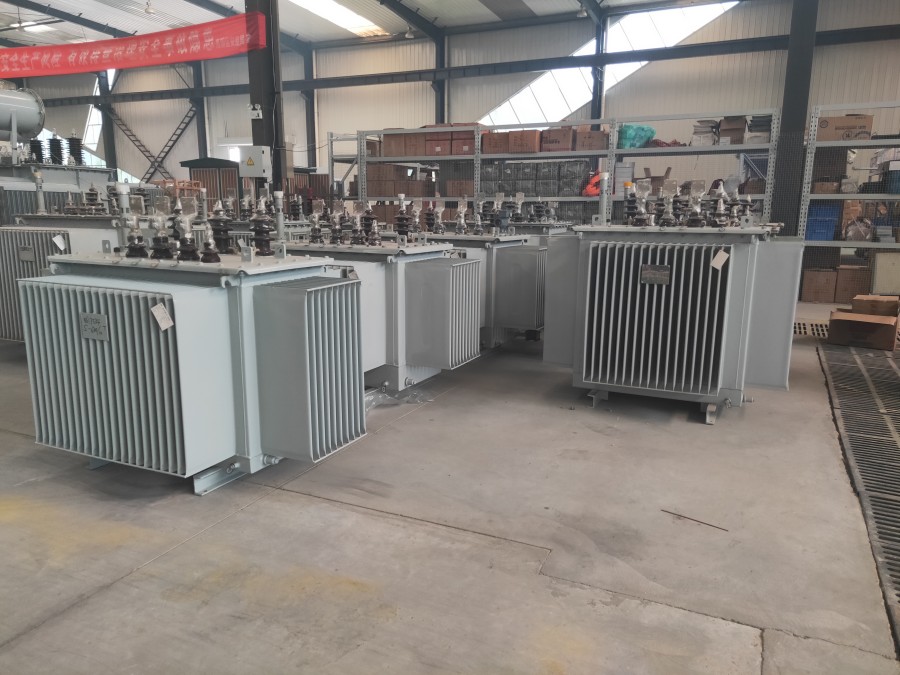
  • Cooling and enclosure: oil tank with radiators and conservator for oil-immersed units; cast-resin windings with air cooling (AN/AF) for dry-type units.
  • Protection and accessories: bushings, Buchholz relay, pressure relief device, temperature sensors, and for dry-type units, IP-rated enclosures and fans.

Common Types of two winding transformer

  • Oil-immersed distribution transformers — S11, S13, S20 and S22 series, typically 30 to 6300 kVA, 10 kV or 35 kV class with 0.4 kV secondary; the higher the series number, the lower the losses.
  • Dry-type transformers — SCB10, SCB13, SCB14 and SCB18 cast-resin units for indoor, fire-sensitive locations such as commercial buildings, hospitals and metro projects.
  • Amorphous alloy transformers — SH15 and SCBH15, using amorphous metal cores to cut no-load loss dramatically, ideal for light-load or continuously energised duty.
  • Special-purpose units — mining transformers, rectifier transformers, lightning arrester and earthing transformers, capacity-regulating transformers and custom designs built to a specific duty cycle.

Correctly identifying which family fits the load profile is the single biggest lever on both purchase price and lifetime energy cost.

Key Parameters to Verify Before You Buy

  • Rated capacity in kVA and duty type: continuous, cyclic or short-time.
  • Voltage ratio and tapping range, for example 10/0.4 kV or 35/0.4 kV with plus or minus 2 by 2.5 percent tappings.
  • Vector group such as Dyn11 or Yyn0, and impedance voltage (Uk percent), which affects short-circuit withstand and parallel operation.
  • No-load loss, load loss and efficiency measured against the applicable energy-efficiency standard.
  • Temperature rise, cooling class, insulation level, altitude and ambient conditions.
  • Enclosure protection (IP rating) and installation environment for dry-type units.

Where a two winding transformer Is Used

  • Utility and industrial distribution networks stepping 10 kV or 35 kV down to 400 V.
  • Factories, mines and process plants that need an isolated low-voltage supply.
  • Renewable energy projects, including wind and solar collector substations.
  • Commercial buildings, data centres, hospitals and rail transit, especially with dry-type units.
  • Compact and preassembled substations, where the transformer is integrated with high and low voltage switchgear.

How to Avoid Overpaying: Practical Procurement Tips

Price is only half of the total cost. A cheap two winding transformer with poor loss performance can cost more over ten years than a premium unit. Run a simple life-cycle calculation: no-load loss multiplied by 8760 hours, plus load loss multiplied by the load factor squared and by operating hours, then multiplied by your electricity tariff. Very often a higher-efficiency S13, S20 or S22 unit, or an amorphous alloy SH15, pays back the price difference within two to four years.

  • Buy from the manufacturer rather than a trading layer, to remove mark-ups and shorten lead time on custom ratings.
  • Specify losses and efficiency to a recognised standard, then compare every offer on the same basis.
  • Confirm copper or aluminium windings in writing — this is the most common source of quiet downgrades.
  • Ask for routine test reports for every unit and type-test certificates for the design.
  • Check the tap changer brand, core grade, insulation class and accessory list, not just the headline price.
  • Confirm warranty terms, spare parts availability and after-sales response time before signing.

Quality Checks That Protect Your Investment

  • Winding resistance and turns-ratio measurement.
  • No-load loss, load loss and impedance voltage tests.
  • Applied voltage and induced voltage dielectric tests.
  • Insulation resistance measurement and oil tests for oil-immersed units, including breakdown voltage and moisture content.
  • Temperature-rise type test and short-circuit withstand evidence.
  • Visual checks: core clamping, winding tightness, paint finish, nameplate data and the completeness of the documentation package.

As a transformer manufacturer holding a broad stock of oil-immersed and dry-type units, Runsheng Transformer Co., Ltd. supplies two winding transformer solutions from 30 to 6300 kVA at factory-direct prices, and ships each unit with a manual, inspection report, test certificate and lifelong quality tracking.

Final thought: treat the two winding transformer as a long-life asset rather than a one-off purchase. Fix the parameters, compare losses honestly, verify the test reports and buy close to the source — that is how experienced buyers keep both the capital budget and the energy bill under control.

Contact: phone +86 13406394988 | e-mail runsheng@7813transformer.com | WhatsApp 008613508930968

When you have coordination challenges, turn to Runsheng Transformer for help
It's all about making things easy, building partnerships, and providing a point of contact.