
When you have coordination challenges, turn to Runsheng Transformer for help
It's all about making things easy, building partnerships, and providing a point of contact.
A power plant transformer is the link between generation and delivery. In thermal, hydro, wind, and solar plants, transformers do two different jobs. Generator step-up transformers raise the voltage from generator level (commonly 10 kV, 13.8 kV, 15.75 kV, or 20 kV) up to the transmission or grid connection level, while station service (auxiliary) transformers step down to 6 kV, 0.4 kV, or 0.69 kV to run pumps, fans, cooling systems, fuel handling, and control equipment. Without reliable transformers, a plant cannot export a single kilowatt-hour, so the choice of design and loss level directly affects availability, auxiliary power consumption, and long-term operating cost.
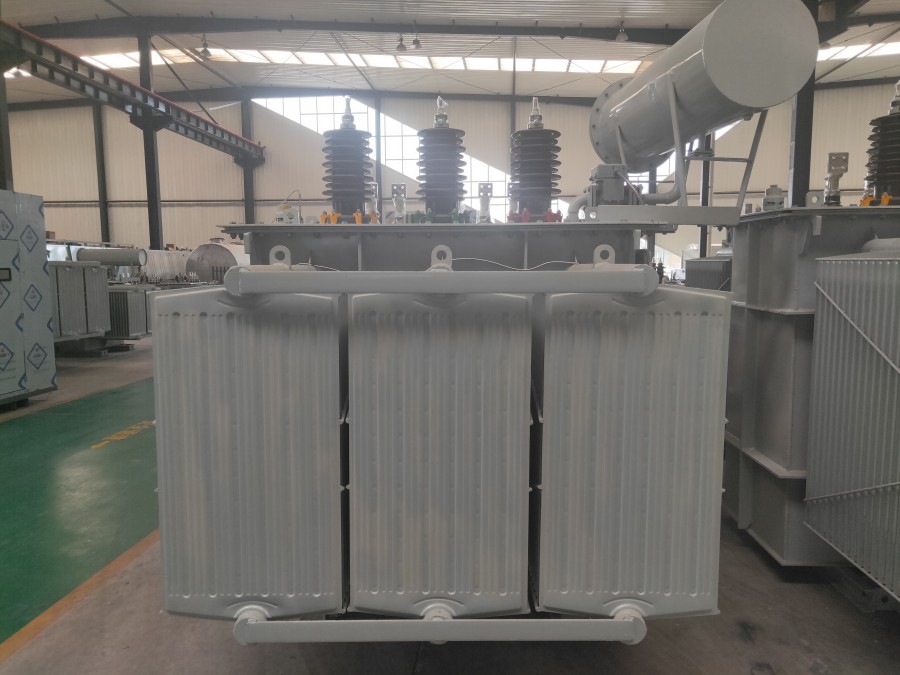
For small and medium plants, distributed generation, and captive power projects, most equipment operates at 35 kV and below, which is the range where standard distribution and station service designs are the most economical choice.
The first decision in any specification is the cooling and insulation medium. Oil-immersed transformers use transformer oil for insulation and heat transfer, offer high capacity in a compact footprint, and suit outdoor installation. Dry-type transformers use cast resin or impregnated insulation and are preferred indoors, in fire-sensitive areas, and where oil containment is impractical.
Loss level is where most of the lifetime cost sits. No-load loss is consumed 8760 hours a year whether the plant is at full load or not, while load loss scales with the square of the current. Across the S11, S13, S20, and S22 generations, each step brings lower no-load loss through improved core steel and winding design; the SCB10 to SCB13, SCB14, and SCB18 progression follows the same logic in cast resin dry-type construction. Selecting a higher efficiency grade costs more up front but usually pays back within a few years in a plant running continuously.
A practical approach is total owning cost evaluation: capital price plus the capitalized value of no-load and load losses over the expected service life. A slightly more expensive high-efficiency unit often wins on this calculation, particularly for station service transformers that run around the clock.
Most problems on site trace back to the specification stage rather than the manufacturing stage. Three issues appear again and again:
Buying through trading layers adds another risk: an unclear manufacturer of record, mismatched spare parts, and slow response on warranty issues. Sourcing directly from the production plant keeps the responsibility chain short.
A transformer is a long-life asset, so the supplier behind it matters as much as the design. Runsheng Transformer Co., Ltd. manufactures S11, S13, S20, and S22 oil-immersed transformers, SCB13, SCB14, and SCB18 dry-type transformers, SH15 amorphous alloy transformers, and 35 kV preassembled substation equipment, keeping a comprehensive inventory with assured quality and offering oil-immersed transformers at factory-direct prices. Every unit complies with national standards and ships with a manual, inspection report, and test certificate, backed by lifelong quality tracking so the plant engineer always has a traceable record.
When comparing quotes, ask each supplier for the same four documents: the routine test report, the guaranteed loss values, the outline and foundation drawings, and the after-sales response commitment. Identical paperwork across bidders makes the price comparison meaningful.
Beyond conventional generation, the same equipment serves wind and solar farms, biomass and waste-to-energy plants, industrial captive power stations, water treatment works, data centers, and large commercial complexes. In each case the selection logic is the same: match voltage ratio and impedance to the network, choose oil-immersed or dry-type according to the installation environment, and pick the efficiency grade that minimizes lifetime cost.
For a project-specific recommendation, the manufacturer can review load profiles, site conditions, and grid requirements and propose a configuration, including custom-designed special transformers where standard catalogue units do not fit.
Contact: phone +86 13406394988, e-mail runsheng@7813transformer.com, WhatsApp 008613508930968.

Runsheng Transformer Co., Ltd. is a professional manufacturer of power transformers, specializing in oil-immersed transformers (S20, S11, S13), SH15 amorphous alloy transformers, S13 series 10KV 3D magnetic path wound-core transformers, D10 single-phase wound-core transformers, as well as mining transformers, rectifier transformers, surge arrestor transformers, load-tap-changing transformers, and custom-engineered special transformers.
WhatsApp & Wechat

No. 6, Intersection of Mount Huangshan Road and Changjiang Road, Liaocheng High tech Industrial Development Zone, Shandong, China


