
When you have coordination challenges, turn to Runsheng Transformer for help
It's all about making things easy, building partnerships, and providing a point of contact.
ONAF stands for Oil Natural Air Forced. In an ONAF transformer the insulating oil moves by natural convection: it heats up in the windings, rises, travels through the radiator banks, cools, and returns. Only the air side is forced, using fans mounted on the radiators. That single detail is why ONAF transformers dominate medium and large oil-immersed power transformer specifications worldwide.
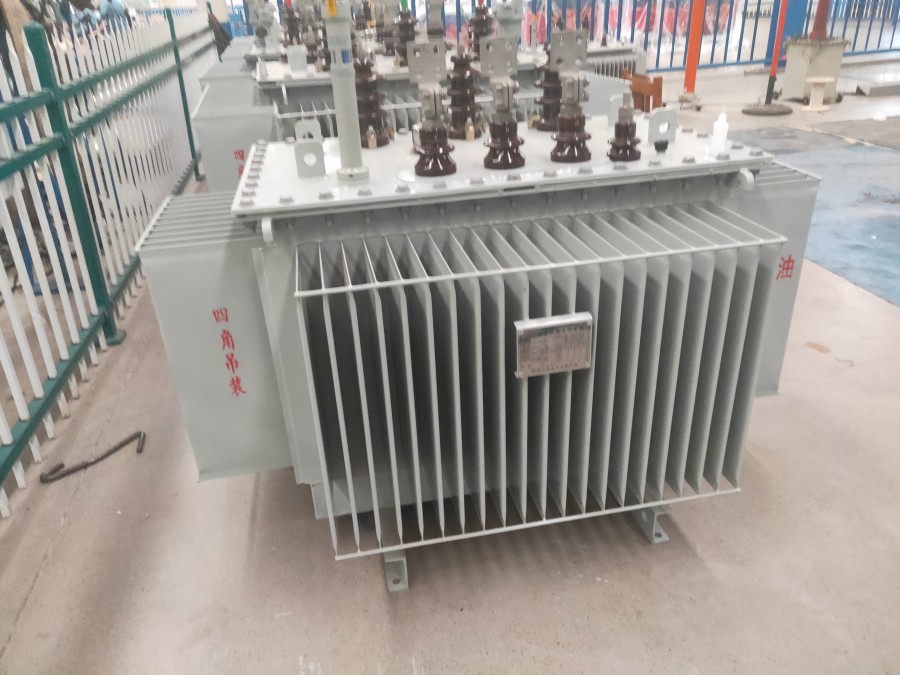
For a buyer, the practical meaning is money: an ONAF transformer is normally ordered with two ratings on one nameplate. A 40/50 MVA unit, for example, delivers 40 MVA with the fans stopped (ONAN) and 50 MVA once the fans run (ONAF). Same tank, same footprint, same foundation, roughly 25 percent more capacity. Reading that dual rating correctly, and verifying it in the test report, is where procurement teams win or lose value.
Heat generated in the windings passes into the oil, the oil rises through the tank and into the radiators, and the fans push ambient air across the radiator fins. The cooled oil sinks back to the bottom of the tank and the loop repeats. Because the oil path is passive, there are no oil pumps to fail, no forced-oil leaks and no additional oil-side maintenance.
Fan operation is staged by control logic rather than by guesswork. Typical designs start the first fan group when top-oil temperature reaches a setpoint, usually somewhere between 65 and 75 degrees Celsius depending on design and ambient, then bring in further groups as oil or winding temperature climbs. Winding temperature indicators and current-based controls add a second trigger so a sudden overload starts cooling early. When load drops, fans stop and the unit returns quietly to ONAN mode.
Two standards matter here: IEC 60076-2 for temperature rise, which sets the familiar limits of 65 K average winding rise by resistance and 60 K top-oil rise, and IEC 60076-7 for loading guidance. Chinese GB 1094 and IEEE C57.12.00 are the equivalents most buyers reference alongside them.
Typical applications include wind and solar collector substations where output fluctuates, industrial plants with peaking loads, mining and heavy-duty sites, utility distribution substations where the footprint is fixed but demand keeps climbing, and retrofit projects that need extra capacity without pouring a new foundation.
Runsheng Transformer Co., Ltd. manufactures oil-immersed units for exactly these duties, including S11, S13, S20 and S22 series transformers, 35 kV and below preassembled substations, mining and rectifier transformers, and custom special transformers. Every unit ships with a manual, inspection report, test certificate and lifelong quality tracking.
Fans consume only a small fraction of rated power, but they run for thousands of hours, so control strategy matters. Good designs run the unit in ONAN mode at part load and bring in fans only above setpoints, which cuts auxiliary energy, reduces fan wear and keeps audible noise lower at night. Poorly sized radiators do the opposite: fans run almost continuously, noise rises by several dB(A) and fan motors become a maintenance item instead of a backup.
When comparing quotations, always compare at the same cooling stage. A cheap offer often quotes the ONAF figure while the radiator area is sized for a lower ONAN rating, so the transformer spends its life with fans running flat out.
Radiator area, fan staging, control logic and test verification are designed together, not bought separately. If you are specifying an ONAF transformer for a substation, renewable energy project or industrial upgrade, ask for the dual rating, the temperature rise test and the fan control scheme in writing before you compare prices.
Contact Runsheng Transformer Co., Ltd. for factory-direct pricing and technical support: phone +86 13406394988, email runsheng@7813transformer.com, WhatsApp 008613508930968.

Runsheng Transformer Co., Ltd. is a professional manufacturer of power transformers, specializing in oil-immersed transformers (S20, S11, S13), SH15 amorphous alloy transformers, S13 series 10KV 3D magnetic path wound-core transformers, D10 single-phase wound-core transformers, as well as mining transformers, rectifier transformers, surge arrestor transformers, load-tap-changing transformers, and custom-engineered special transformers.
WhatsApp & Wechat

No. 6, Intersection of Mount Huangshan Road and Changjiang Road, Liaocheng High tech Industrial Development Zone, Shandong, China


