
When you have coordination challenges, turn to Runsheng Transformer for help
It's all about making things easy, building partnerships, and providing a point of contact.
An oil cooled transformer is a power or distribution transformer in which insulating oil does two jobs at the same time: it electrically insulates the windings and it carries heat away from the core and coils to the tank walls and radiators. Because liquid cooling is far more efficient than air alone, an oil cooled transformer can handle a large capacity in a relatively compact footprint. That is the main reason the overwhelming majority of distribution transformers in service worldwide, from 30 kVA pole-mounted units to 6300 kVA substation units, are oil filled rather than air cooled.
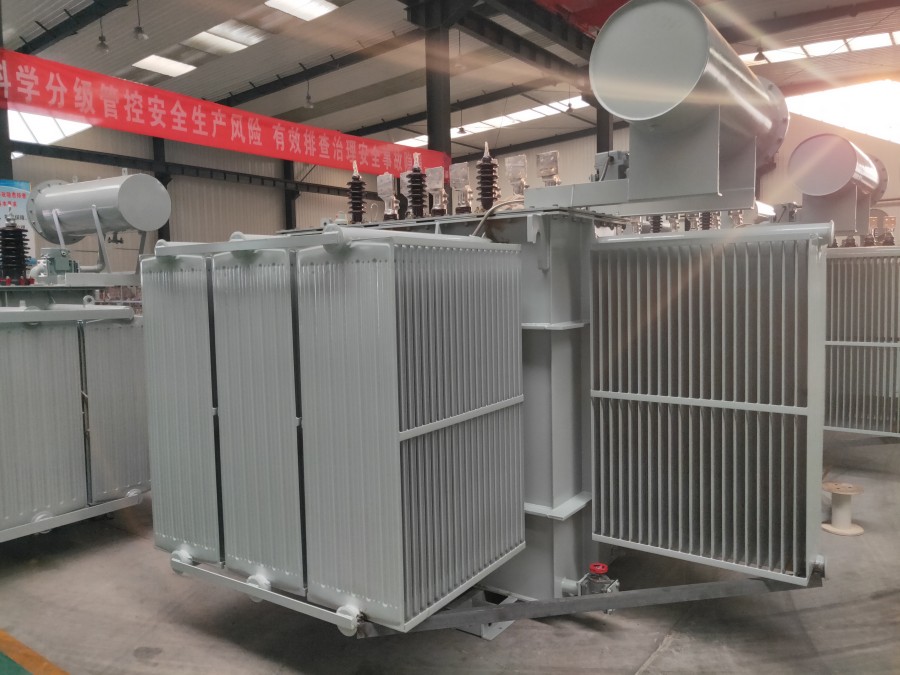
For buyers, the practical takeaway is simple: the oil cooled transformer is the workhorse product of the power distribution network, it is mature, it is cost effective per kVA, and it survives outdoor conditions well when it is correctly specified and maintained.
Heat inside a transformer comes from two sources: no-load loss in the core laminations and load loss in the copper windings. In an oil cooled transformer, the oil heats up as it passes over these hot surfaces, becomes lighter, rises to the top of the tank, and then flows down through radiators or corrugated tank walls where ambient air removes the heat. The cooled oil returns to the bottom of the tank and the cycle repeats by natural convection.
The cooling class on the nameplate tells you exactly what the unit is rated for, and it should always match the required load profile of your site rather than simply the lowest purchase price.
The Chinese and international markets use a series numbering system that indicates loss level and design generation. The higher the series number, the lower the losses and the higher the initial cost, but the lower the electricity bill over the 20-30 year service life.
If the unit goes outdoors, serves a large capacity, faces overload conditions or must hit a tight budget, an oil cooled transformer is normally the better engineering and commercial answer. If the unit must sit indoors in a basement, inside a hospital, a shopping mall or a high-rise where fire safety and the absence of an oil bund are decisive, the dry-type range, from the SCB10 dry-type transformer up to the SCB18 dry-type transformer, is usually preferred despite its higher cost per kVA.
Because the oil cooled transformer sits at the center of the distribution network, supplier stability matters as much as the price tag. A manufacturer with a broad in-house range can cover an entire project, from S11, S13, S20 and S22 distribution units to SCB series dry-type units, SH15 amorphous alloy transformers and 35 kV preassembled substation equipment including European-style and American-style compact substations and high/low-voltage switchgear. Companies such as Runsheng Transformer Co., Ltd. supply this complete portfolio at factory-direct prices, with every unit tested to national standards and delivered with full documentation and lifelong quality tracking, which removes the middleman markup and the risk of unmatched equipment on site.
In short, treat the oil cooled transformer as a long-life asset rather than a commodity: state your loss requirements, ask for test documentation, verify the cooling class and temperature rise, and buy directly from a manufacturer who can support the unit for its full service life.
For technical selection or a quotation, contact: phone +86 13406394988, e-mail runsheng@7813transformer.com, WhatsApp 008613508930968.

Runsheng Transformer Co., Ltd. is a professional manufacturer of power transformers, specializing in oil-immersed transformers (S20, S11, S13), SH15 amorphous alloy transformers, S13 series 10KV 3D magnetic path wound-core transformers, D10 single-phase wound-core transformers, as well as mining transformers, rectifier transformers, surge arrestor transformers, load-tap-changing transformers, and custom-engineered special transformers.
WhatsApp & Wechat

No. 6, Intersection of Mount Huangshan Road and Changjiang Road, Liaocheng High tech Industrial Development Zone, Shandong, China


