
When you have coordination challenges, turn to Runsheng Transformer for help
It's all about making things easy, building partnerships, and providing a point of contact.
An OFAF transformer is an oil-immersed power transformer whose cooling system is active on both sides of the heat path. Oil pumps push the insulating fluid through the radiator bank and winding ducts, while fans blow ambient air across the radiator fins. In the standard cooling-class notation used by IEC 60076 and GB 1094, OFAF sits above ONAF and ONAN: once natural oil convection is no longer enough to hold temperature rise within limits, forced oil flow becomes the next step.
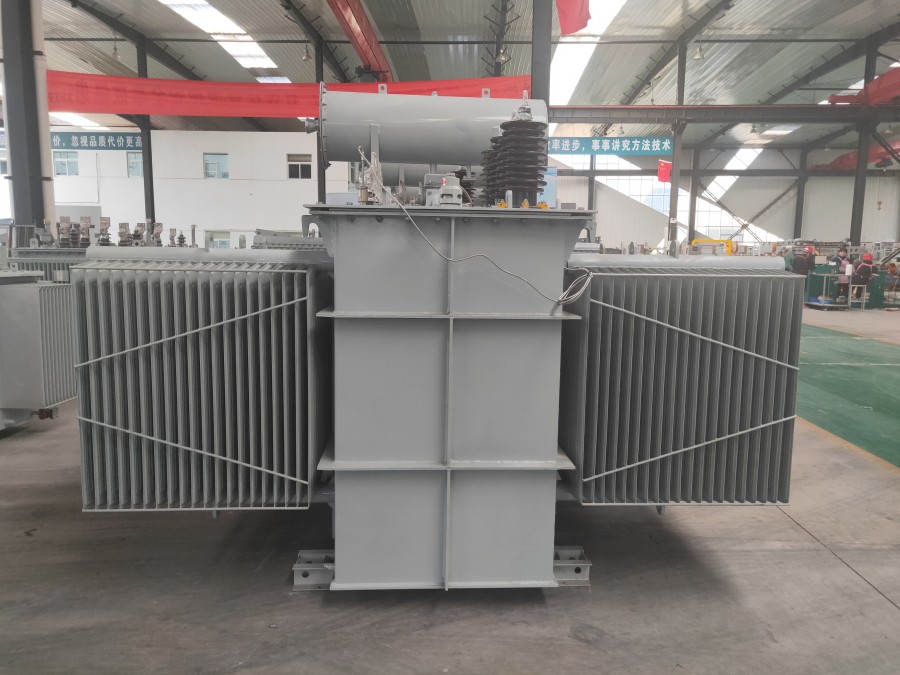
The practical consequence is simple. Because heat leaves the windings much faster, an OFAF transformer can be built with a smaller tank and a tighter core-and-coil assembly for the same MVA, or can hold its temperature rise in a high-ambient site where a naturally cooled unit would be derated. For anyone specifying medium and large oil-immersed units, understanding the OFAF stage is the difference between a transformer that runs comfortably for thirty years and one that trips on hot afternoons every summer.
Most large oil-immersed transformers are not locked into a single cooling class. They are delivered with a staged rating, and the control cabinet switches stages according to top-oil temperature and, on better designs, winding hot-spot temperature. A typical progression looks like this:
The exact capacity gained at each stage is not a universal number. It is set by the manufacturer's thermal model and must be confirmed during the routine temperature-rise test, so always ask for the test report rather than accepting a catalogue percentage.
The trade-off is auxiliary power, pump and fan maintenance, and a control system that has to be right. That is why the cooling cabinet, redundancy arrangement and protection logic deserve as much attention in the specification as the winding itself.
OFAF cooling appears wherever load is heavy and continuous or where ambient conditions are punishing: utility substations at 35kV and above, step-up transformers for wind and solar farms, industrial plant main transformers, rectifier and furnace duty, traction supply, and dense urban substations where the footprint is constrained. Renewable energy projects in particular favour OFAF and ODAF designs because output fluctuates and the transformer must ride through peak generation without exceeding its thermal envelope.
Buyers who compare only the purchase price usually lose. Two cost elements dominate life-cycle economics:
Other price drivers include winding material, tap changer brand, radiator surface area, transport weight limits and whether site assembly is included. Comparing offers line by line on these items is the fastest way to spot a quotation that has been quietly stripped down.
Cutting out trading layers is the most reliable way to reduce cost without touching the design. A manufacturer with its own winding, core stacking, drying, oil processing and test bay can quote the real build cost and stand behind the result. Runsheng Transformer Co., Ltd. produces S11, S13, S20 and S22 oil-immersed transformers, SCB10, SCB13, SCB14 and SCB18 dry-type transformers, SH15 and SCBH15 amorphous alloy transformers, mining and rectifier transformers, and 35kV and below preassembled substations with high and low voltage switchgear, covering roughly 30 to 6300 kVA with factory-direct pricing and full documentation for every unit.
Before releasing a purchase order, verify three things: the factory witness test or a complete routine test report, the guaranteed loss values written into the contract, and the after-sales tracking commitment. Any serious supplier will provide all three without hesitation.
Getting the cooling class, the staged ratings and the loss guarantees right at the enquiry stage is worth more than any discount negotiated later. For specification support, drawings or a factory-direct quotation, contact Runsheng Transformer Co., Ltd. at +86 13406394988, runsheng@7813transformer.com, or WhatsApp 008613508930968.

Runsheng Transformer Co., Ltd. is a professional manufacturer of power transformers, specializing in oil-immersed transformers (S20, S11, S13), SH15 amorphous alloy transformers, S13 series 10KV 3D magnetic path wound-core transformers, D10 single-phase wound-core transformers, as well as mining transformers, rectifier transformers, surge arrestor transformers, load-tap-changing transformers, and custom-engineered special transformers.
WhatsApp & Wechat

No. 6, Intersection of Mount Huangshan Road and Changjiang Road, Liaocheng High tech Industrial Development Zone, Shandong, China


