
When you have coordination challenges, turn to Runsheng Transformer for help
It's all about making things easy, building partnerships, and providing a point of contact.
OFAF transformer is the standard designation, taken from the IEC 60076-2 cooling-class system, for an oil-immersed transformer that relies on forced oil circulation and forced air circulation. The letters decode logically: O and F describe the internal cooling medium and how it moves (oil, forced), while A and F describe the external medium and how it moves (air, forced). An OFAF transformer therefore combines oil pumps that drive the coolant through the tank, radiators or heat exchangers with motor-driven fans that push air across the cooling surfaces.
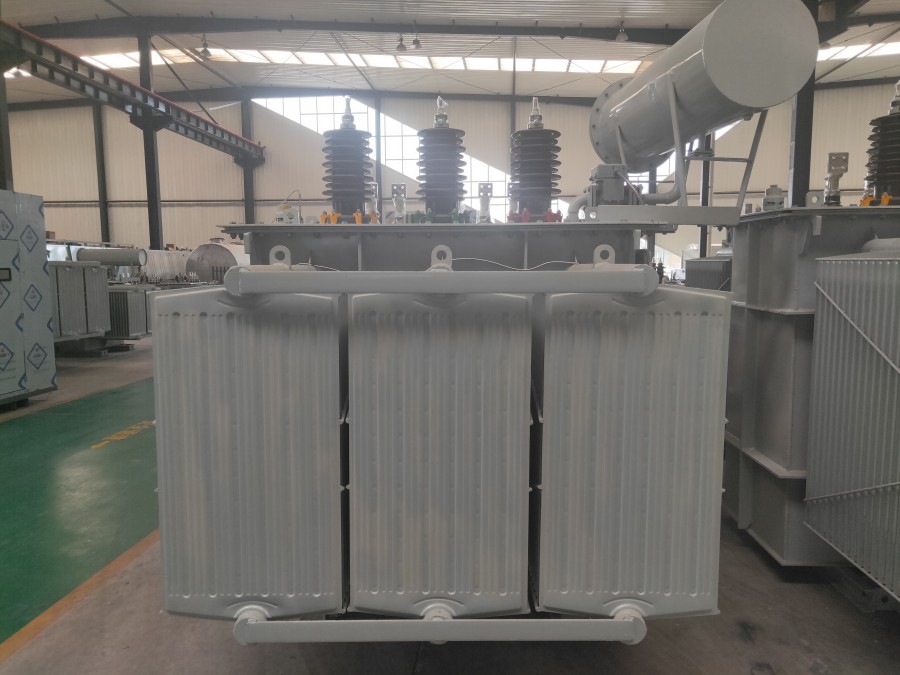
That mechanical assistance is what separates an OFAF transformer from the far more common ONAN (oil natural, air natural) distribution unit on a pole or inside a compact substation. Natural cooling depends on buoyancy and radiation alone; forced cooling uses electrical energy to move heat out much faster, so more megavolt-amperes can be pushed through the same core-and-coil assembly without exceeding its temperature limits.
Inside the tank, one or more oil pumps draw hot oil from the top of the transformer and push it through external coolers — usually radiator banks or plate-fin heat exchangers — before returning it, cooled, to the bottom of the tank. Fans mounted on the cooler banks force ambient air across the fins, raising the heat-transfer coefficient on the air side. Both sides of the thermal path are enhanced at once, which is why OFAF transformer cooling is substantially more effective than either ONAF (forced air only) or forced-oil-only arrangements.
Most large OFAF transformer designs are specified with staged cooling, quoted as ONAN/ONAF/OFAF ratings. The unit runs quietly on natural cooling at light load, brings fans online as temperature rises, and starts the oil pumps only when load or ambient conditions demand the full forced-oil rating. That staged arrangement improves efficiency, reduces auxiliary power consumption and extends fan and pump life.
Selecting between them is a thermal and economic trade-off, not a prestige choice. An OFAF transformer costs more than an ONAF unit of the same rating because of the pumps, controls and more complex cooler assembly, but it can reduce the physical size and mass of the transformer for a given power throughput — which matters when the substation building, transport route or foundation is already fixed.
OFAF transformer cooling appears across the power system wherever the ratio of load to available space is high:
Because the cooling system defines the guaranteed rating, tender documents for an OFAF transformer should pin down more than the nameplate MVA:
Getting these wrong is the classic oversizing trap: buyers pay for forced-cooling capability the load profile never needs, or specify a single-stage OFAF rating and then discover the unit cannot run safely at light load with the pumps out of service.
An OFAF transformer is not a fit-and-forget asset. Pumps and fans are the only continuously moving parts on the unit, and their condition drives availability. A practical maintenance programme includes routine inspection of fan blades and motor bearings, checks on pump differential pressure and oil-flow indicators, thermographic scanning of cooler connections, and periodic dissolved gas analysis of the oil to catch overheating or arcing long before it becomes a failure. Control cabinets need their temperature sensors and stage-change logic tested, because a fan that fails to start silently converts an OFAF transformer into an under-cooled ONAN unit — and the first symptom is accelerated insulation ageing.
Cooling class, rating stages and cooler layout are design decisions made at the factory, so the specification conversation is far more productive with the manufacturer than with a trading company. Runsheng Transformer Co., Ltd. produces oil-immersed transformers from 30 kVA to 6300 kVA and above — including the S11, S13, S20 and S22 series — alongside SCB10, SCB13, SCB14 and SCB18 dry-type units, SH15 and SCBH15 amorphous alloy transformers, mining and rectifier transformers, and 35 kV preassembled and compact substations. Each unit ships with a manual, inspection report and test certificate, backed by lifelong quality tracking.
Buying direct also keeps the price conversation honest: factory-direct pricing means no intermediary margin layered onto the cooler package, the pumps or the control cabinet.
Is an OFAF transformer better than ONAF? It cools more effectively per unit of surface area, but it also adds auxiliary power, moving parts and maintenance. It is the better choice when load or space constraints justify it.
Can the pumps be switched off? Only within the natural or forced-air rating published by the manufacturer. Running at the OFAF rating with pumps stopped is a thermal risk, not a saving.
Which standard governs the designation? IEC 60076-2 defines the cooling-class letter codes; GB 1094 and IEEE C57.12.00 cover related requirements regionally.
Contact us for a cooling-class review before you tender: phone +86 13406394988, e-mail runsheng@7813transformer.com, WhatsApp 008613508930968.

Runsheng Transformer Co., Ltd. is a professional manufacturer of power transformers, specializing in oil-immersed transformers (S20, S11, S13), SH15 amorphous alloy transformers, S13 series 10KV 3D magnetic path wound-core transformers, D10 single-phase wound-core transformers, as well as mining transformers, rectifier transformers, surge arrestor transformers, load-tap-changing transformers, and custom-engineered special transformers.
WhatsApp & Wechat

No. 6, Intersection of Mount Huangshan Road and Changjiang Road, Liaocheng High tech Industrial Development Zone, Shandong, China


