
When you have coordination challenges, turn to Runsheng Transformer for help
It's all about making things easy, building partnerships, and providing a point of contact.
ODAF is a cooling class designation, not a separate product family. Under the IEC 60076 and IEEE C57.12 cooling-code system, every letter carries a specific meaning: O for mineral oil as the internal cooling medium, D for directed oil circulation through the winding ducts, A for air as the external cooling medium, and F for forced air circulation delivered by fans. An ODAF transformer, therefore, is an oil-immersed transformer in which oil is pumped and guided through the windings while fans push air across the heat exchanger.
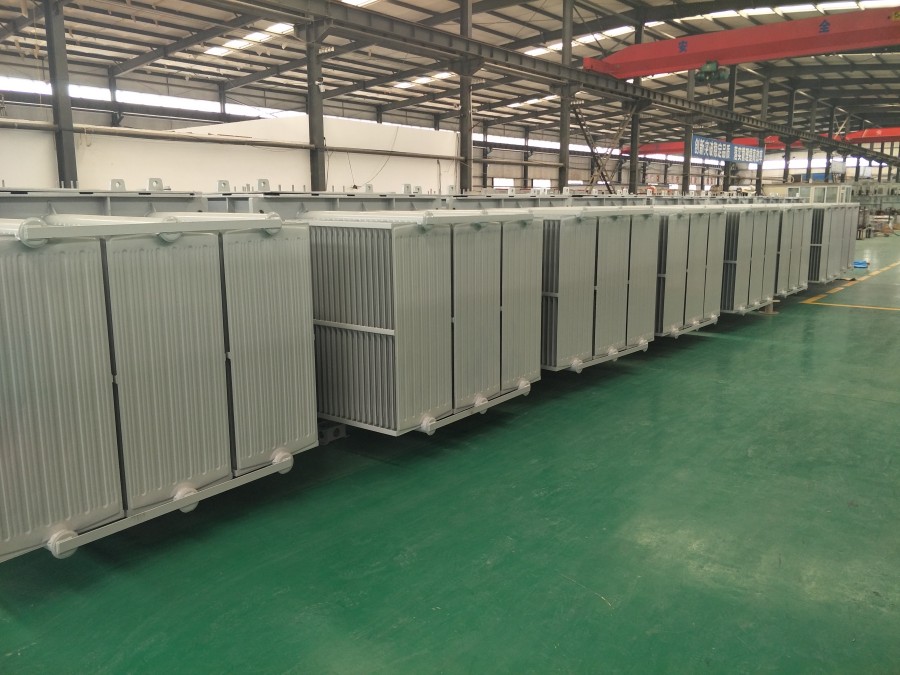
The word directed is the part buyers most often overlook. In a conventional oil-immersed unit, oil moves largely by natural convection and may bypass parts of the winding. In an ODAF transformer, dedicated pumps and internal barriers force the oil along defined paths inside the winding ducts, so every section of conductor receives a predictable flow. That controlled flow is what makes ODAF cooling so effective in large, heavily loaded power transformers where hot-spot control dictates insulation life.
Although the concept is simple, an ODAF transformer is a coordinated thermal system. A typical arrangement includes:
Because pumps and fans consume auxiliary power and require redundancy, an ODAF transformer is normally specified where natural circulation or simple forced-air cooling cannot meet the thermal duty within a reasonable footprint.
Understanding the neighbouring cooling codes helps you judge whether ODAF is genuinely required or simply oversizing your budget:
ODAF cooling appears most often in applications where load density and site constraints collide:
ODAF transformer pricing is driven by copper, core steel, cooler surface area and control complexity, so vague specifications always cost money. Confirm the following before ordering:
An ODAF transformer adds rotating equipment, so maintenance planning matters. Practical measures include monthly inspection of pump and fan operation, checking differential pressure across coolers, oil-flow indicator verification, leak checks on pump seals and gaskets, and periodic dissolved gas analysis. Keeping a spare pump and fan motor on site is inexpensive compared with a forced outage. Modern units with intelligent monitoring can trend winding temperature and cooling-stage run hours, which supports condition-based servicing instead of fixed-interval overhauls.
Because ODAF cooling is usually specified for high-value power transformers, the difference between a well-matched design and an oversized one can be substantial. A manufacturer that builds both oil-immersed and dry-type ranges can compare ONAN, ONAF and ODAF options on the same thermal basis and recommend the lowest total-cost configuration rather than the largest machine. Runsheng Transformer Co., Ltd. produces S11, S13, S20 and S22 oil-immersed transformers, SCB10, SCB13, SCB14 and SCB18 dry-type transformers, SH15 amorphous alloy units, mining and rectifier transformers, plus 35 kV preassembled and compact substations, and supplies each unit with manuals, inspection reports, test certificates and lifelong quality tracking so that cooling performance is verifiable long after commissioning.
An ODAF transformer is the right answer when thermal headroom, footprint or overload duty cannot be met by natural or simple forced cooling. Match the cooling class to the real load profile, insist on documented temperature-rise and loss guarantees, plan pump and fan redundancy from day one, and buy from a source that can show you the test data. For technical selection support, quotations or custom special transformer design, contact Runsheng Transformer Co., Ltd. at +86 13406394988, runsheng@7813transformer.com or WhatsApp 008613508930968.

Runsheng Transformer Co., Ltd. is a professional manufacturer of power transformers, specializing in oil-immersed transformers (S20, S11, S13), SH15 amorphous alloy transformers, S13 series 10KV 3D magnetic path wound-core transformers, D10 single-phase wound-core transformers, as well as mining transformers, rectifier transformers, surge arrestor transformers, load-tap-changing transformers, and custom-engineered special transformers.
WhatsApp & Wechat

No. 6, Intersection of Mount Huangshan Road and Changjiang Road, Liaocheng High tech Industrial Development Zone, Shandong, China


