
When you have coordination challenges, turn to Runsheng Transformer for help
It's all about making things easy, building partnerships, and providing a point of contact.
An oil cooled transformer is a power or distribution transformer whose core and windings are immersed in insulating oil inside a sealed steel tank. The oil does two jobs at the same time: it insulates the live parts and it carries heat away from the windings to the tank walls and radiators, where it is released into the surrounding air. Because oil circulates naturally or with forced pumps, this cooling method handles high loads reliably and keeps internal temperatures within safe limits, which is why oil cooled transformer units dominate medium-voltage distribution networks worldwide.
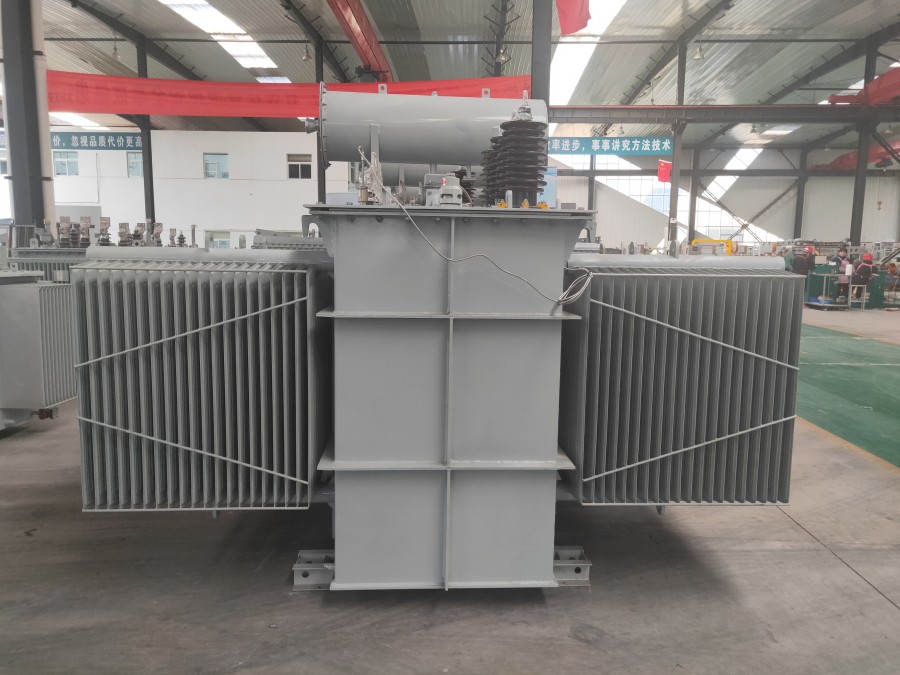
In most standard designs the cooling mode is ONAN (oil natural, air natural). Larger units may use ONAF with fans, or forced oil circulation for heavy duty applications. The basic structure includes the core, windings, oil tank, radiator or corrugated tank wall, conservator, breather, Buchholz relay on larger units, off-circuit or on-load tap changer, and high and low voltage bushings.
Buyers usually compare a handful of well-established series. Knowing the naming logic helps you read a quotation quickly:
Dry-type alternatives such as SCB10, SCB13, SCB14, SCB18 and SGB10 are used where oil is not permitted, for example indoors in high fire-risk areas. For outdoor and standard distribution duty, an oil cooled transformer generally offers better overload capacity and a lower price per kVA.
The specification sheet is where money is made or lost. Always confirm these values in writing:
These units serve power plants, urban and rural distribution networks, industrial plants, commercial buildings, water treatment facilities and infrastructure projects. They are also common in renewable energy transformer applications, connecting wind and solar generation to the grid, and in mining and heavy industry where dust, moisture and continuous load are normal. In compact substations and preassembled substation packages, the oil cooled transformer sits alongside high and low voltage switchgear as a factory-built, site-ready solution.
Price differences between suppliers are rarely random. They usually come from winding material, core material, loss level, tank construction, accessory package and test scope. A cheap quotation often hides aluminium windings where copper was expected, losses that only just pass or even miss the standard, thinner tank steel, or a reduced accessory set.
As a power transformer manufacturer with a broad catalogue covering oil-immersed, dry-type and amorphous alloy transformers, Runsheng Transformer Co., Ltd. supplies S11, S13, S20 and S22 oil-immersed transformer series, SCB10/SCB13/SCB14/SCB18 dry-type units, SH15 and SCBH15 amorphous alloy transformers, 35kV transformers, mining and rectifier transformers, plus compact substations and high and low voltage switchgear. Products are manufactured to national standards and delivered with manuals, inspection reports, test certificates and lifelong quality tracking.
Correct installation extends life significantly. Mount the unit on a level foundation with adequate ventilation and clearance for radiator airflow, follow the earthing requirements, and check oil level and tightness before energizing. During operation, periodic oil sampling for dielectric strength and moisture, inspection of the silica gel colour, leak checks on gaskets and weld seams, and verification of the breather and pressure relief device are the core routine tasks. With proper care, a well-built oil cooled transformer will run for decades.
To receive a precise offer, prepare the following: rated capacity in kVA, primary and secondary voltage, phase and frequency, vector group, impedance, loss level or efficiency class, cooling method, tap changer type, indoor or outdoor installation, ambient and altitude conditions, and any special requirements such as mining, rectifier or capacity-regulating duty. Sharing this information avoids re-quoting and keeps delivery on schedule.
For technical selection, pricing or customization of an oil cooled transformer, contact Runsheng Transformer Co., Ltd. at phone +86 13406394988, e-mail runsheng@7813transformer.com, or WhatsApp 008613508930968.

Runsheng Transformer Co., Ltd. is a professional manufacturer of power transformers, specializing in oil-immersed transformers (S20, S11, S13), SH15 amorphous alloy transformers, S13 series 10KV 3D magnetic path wound-core transformers, D10 single-phase wound-core transformers, as well as mining transformers, rectifier transformers, surge arrestor transformers, load-tap-changing transformers, and custom-engineered special transformers.
WhatsApp & Wechat

No. 6, Intersection of Mount Huangshan Road and Changjiang Road, Liaocheng High tech Industrial Development Zone, Shandong, China


