
When you have coordination challenges, turn to Runsheng Transformer for help
It's all about making things easy, building partnerships, and providing a point of contact.
Transformer cooling classes are written as short letter codes, and every letter matters. In OFAF transformer, the first pair means Oil Forced and the second pair means Air Forced: a pump pushes the insulating oil through the cooling ducts inside the windings and core, while fans drive air across the radiator or cooler bank outside. Because both sides of the heat path are actively driven, heat rejection is far higher than on a naturally cooled unit of the same tank size. In procurement terms this delivers three benefits: more MVA from the same footprint, lower temperature rise at the same load, or a lighter and more compact unit for the same rating. That matters on space-constrained sites such as urban substations, containerised installations and retrofits where the building cannot be enlarged.
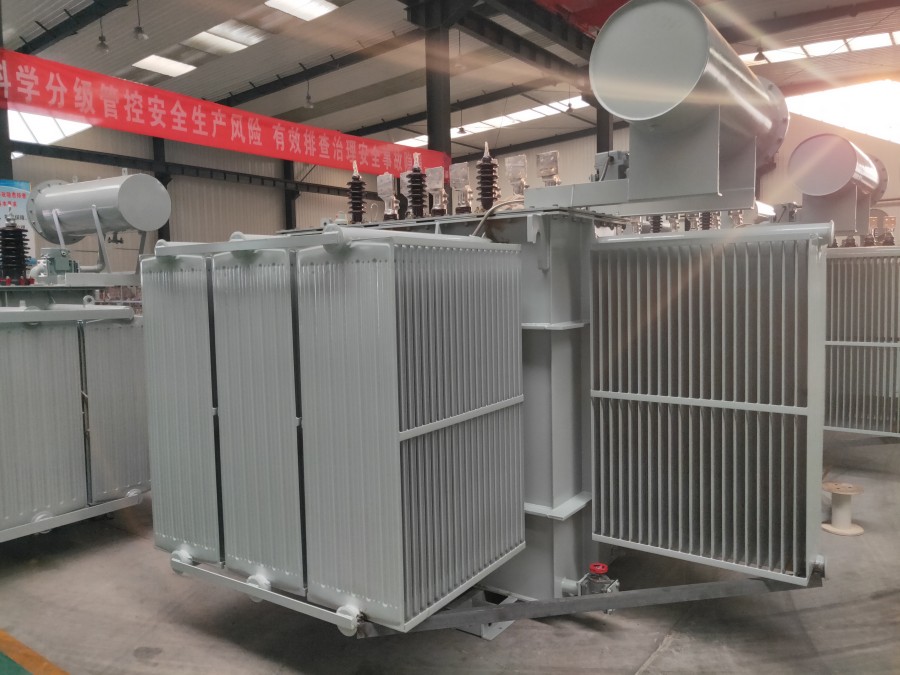
Most OFAF transformer designs are not forced-cooled all the time. They are built as staged-cooling units that switch cooling capacity on and off according to oil and winding temperature:
This is why a nameplate often shows three figures, for example 40/50/63 MVA, and why the cooling class is written as ONAN/ONAF/OFAF. The control cabinet, pump and fan starters, oil flow indicators and winding temperature device are therefore part of the rating, not accessories. If the cooling control system is unreliable, the third rating does not exist in practice.
Two bids can look identical and still differ by a wide margin because one is quoted at the ONAN rating only, while the other includes the full OFAF rating with pumps, fans and a functionally tested control cabinet.
Price gaps of 20 to 30 percent between suppliers are normal and usually traceable to a handful of cost drivers:
For an OFAF transformer, insist on functional testing of the cooling system, not just electrical tests: pump and fan changeover, loss-of-flow alarm, pressure relay behaviour and duplication of control power supplies. Routine tests should cover winding resistance, ratio, vector group, impedance and load loss, no-load loss and current, insulation resistance, applied and induced voltage, and oil dielectric strength. A temperature rise test on a representative design, or a full type test on the ordered unit, is the only reliable evidence that the OFAF rating is real rather than a calculation on paper.
Runsheng Transformer Co., Ltd. builds oil-immersed and dry-type transformers, including S11, S13, S20 and S22 oil-immersed units, SCB10 to SCB18 dry-type units, SH15 amorphous alloy transformers and custom special transformers, alongside 35 kV and below preassembled substations and high and low voltage switchgear. Units ship with manuals, inspection reports and test certificates, backed by lifelong quality tracking. For projects where the OFAF transformer rating, cooling control and delivery schedule all have to line up, that combination of product range and documentation is often what decides the order.
Prepare a data sheet with the three ratings, losses, impedance, cooling redundancy and test scope before you ask for quotations. It is the fastest way to get comparable offers and to avoid paying for a rating the cooling system cannot actually deliver.
Contact: phone +86 13406394988 | email runsheng@7813transformer.com | WhatsApp 008613508930968.

Runsheng Transformer Co., Ltd. is a professional manufacturer of power transformers, specializing in oil-immersed transformers (S20, S11, S13), SH15 amorphous alloy transformers, S13 series 10KV 3D magnetic path wound-core transformers, D10 single-phase wound-core transformers, as well as mining transformers, rectifier transformers, surge arrestor transformers, load-tap-changing transformers, and custom-engineered special transformers.
WhatsApp & Wechat

No. 6, Intersection of Mount Huangshan Road and Changjiang Road, Liaocheng High tech Industrial Development Zone, Shandong, China


