
When you have coordination challenges, turn to Runsheng Transformer for help
It's all about making things easy, building partnerships, and providing a point of contact.
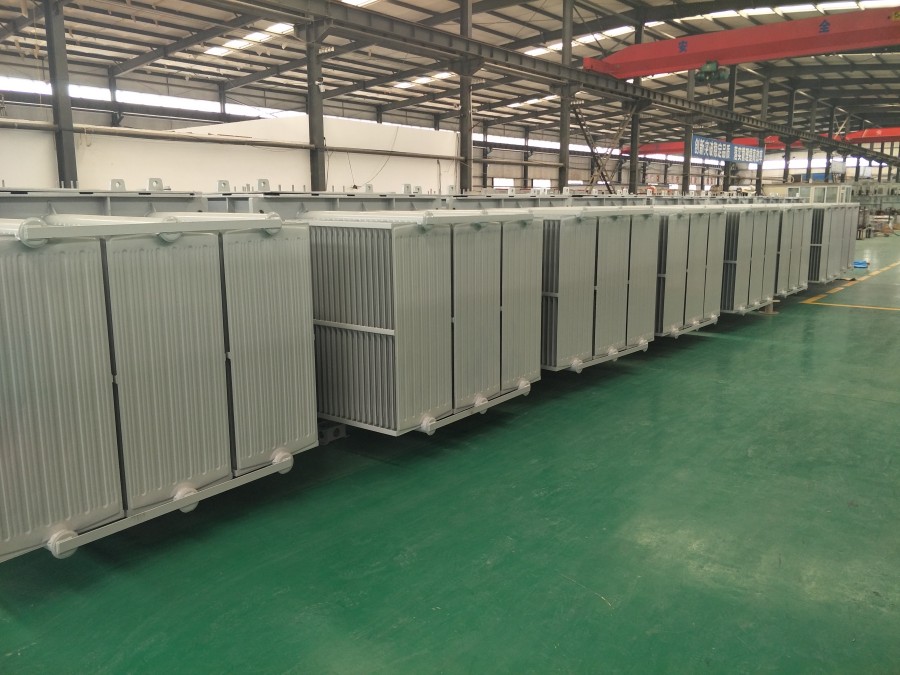
A three phase power transformer sits at the heart of almost every industrial, commercial and utility installation. It takes the medium-voltage supply delivered by the grid, usually 10 kV or 35 kV, and steps it down to the 400/230 V that motors, drives, lighting and building systems actually run on. Three-phase transmission and distribution carry a given load with far less conductor material than an equivalent single-phase arrangement, which is why the three phase power transformer remains the most economical and most widely deployed transformation solution worldwide. This overview explains what these units do, how the main types differ, which parameters decide quality and price, and how to avoid the most common purchasing mistakes.
Every transformer relies on electromagnetic induction. Alternating current in the primary winding creates an alternating magnetic flux in a laminated steel core, and that flux induces a voltage in the secondary winding. Because the voltage ratio follows the turns ratio, a transformer can step voltage up or down with only small losses. In a three phase power transformer, three winding sets share a common magnetic circuit, normally built as a three-limb core. The high-voltage and low-voltage windings are wound concentrically around each limb, insulated from each other and from the core, then clamped and braced to withstand the mechanical forces produced by short-circuit currents.
Two parameters describe the losses. No-load loss occurs whenever the unit is energised, even with no load connected, and depends mainly on core material and flux density. Load loss varies with the square of the current and depends mainly on winding conductor cross-section and design current density. Together they determine the efficiency class of the transformer and, over a 20 to 30 year service life, usually outweigh the purchase price difference between models.
As a rule of thumb, choose an oil-immersed transformer wherever the unit can be installed outdoors or in a dedicated oil containment room, and choose dry-type where the installation is inside an occupied building.
The letters and numbers in a Chinese model designation are not arbitrary. In oil-immersed types, S means three-phase and the number indicates the loss level of the design, so S11, S13, S20 and S22 represent progressively lower no-load loss and therefore higher energy efficiency grades. Suffixes such as M indicate a sealed tank, MR indicates a sealed type with conservator features, and RL indicates a wound-core three-dimensional magnetic circuit that shortens the flux path and further reduces no-load loss. SH15 and SCBH15 use amorphous alloy cores, whose very thin metallic ribbon and low flux density give the lowest no-load loss of all, making them attractive where the transformer runs lightly loaded for long hours, such as in rural distribution or renewable energy collection.
For dry-type units, SCB means a three-phase cast-resin transformer with a laminated core, and the number again denotes the loss level: SCB10, SCB13, SCB14 and SCB18 step up in efficiency, while SGB10 refers to a dry-type design with a different cooling and construction arrangement. In practice, S13, S20, S22, SCB13, SCB14 and SCB18 designs are now the mainstream choices because they already meet modern efficiency limits, while older S9 or SCB9 designs are being phased out of new projects.
Applications range from utility distribution feeders and industrial plant rooms to renewable energy projects, where transformers step up inverter or turbine output, and to heavy industry, where rectifier transformers feed electrolysis and smelting lines, mining transformers supply underground workings, and purpose-built units serve lightning arrester testing, capacity regulation and other special duties. Many projects are best served by a preassembled substation that combines the transformer, high-voltage switchgear and low-voltage switchgear in a single tested enclosure, cutting site work and footprint.
Buying from the manufacturing source is the simplest way to control both cost and specification. A factory that builds the core, winds the coils and performs its own routine tests can confirm loss figures, adjust tapping ranges and supply documentation that matches the delivered unit.
Runsheng Transformer Co., Ltd. manufactures oil-immersed transformers, dry-type transformers, amorphous alloy transformers, mining and rectifier transformers, plus 35 kV and below preassembled substations with high and low voltage switchgear. Units are produced to national standards and shipped with manuals, inspection reports and test certificates, backed by lifelong quality tracking. Because the company sells at factory-direct prices with a comprehensive inventory, buyers can compare loss levels, dimensions and lead times directly with the people who build the transformer.
If you are specifying a three phase power transformer for a new project or replacing an aging unit, send the capacity, voltage ratio, vector group, installation environment and expected load profile, and request a quotation with both standard and high-efficiency options. Comparing those two figures side by side is usually the fastest way to see the real cost of ownership.
Contact: phone +86 13406394988 | email runsheng@7813transformer.com | WhatsApp 008613508930968

Runsheng Transformer Co., Ltd. is a professional manufacturer of power transformers, specializing in oil-immersed transformers (S20, S11, S13), SH15 amorphous alloy transformers, S13 series 10KV 3D magnetic path wound-core transformers, D10 single-phase wound-core transformers, as well as mining transformers, rectifier transformers, surge arrestor transformers, load-tap-changing transformers, and custom-engineered special transformers.
WhatsApp & Wechat

No. 6, Intersection of Mount Huangshan Road and Changjiang Road, Liaocheng High tech Industrial Development Zone, Shandong, China


