
When you have coordination challenges, turn to Runsheng Transformer for help
It's all about making things easy, building partnerships, and providing a point of contact.
An oil immersed distribution transformer is the workhorse of every low and medium voltage grid. It steps voltage down from a distribution feeder, typically 10 kV or 35 kV, to the 400 V / 230 V level that factories, commercial buildings and residential areas actually use. The core and windings are submerged in insulating oil inside a sealed steel tank, and that oil does two jobs at once: it insulates the live parts and it carries heat away from the windings to the tank walls, where natural air circulation (ONAN cooling) releases it to the environment.
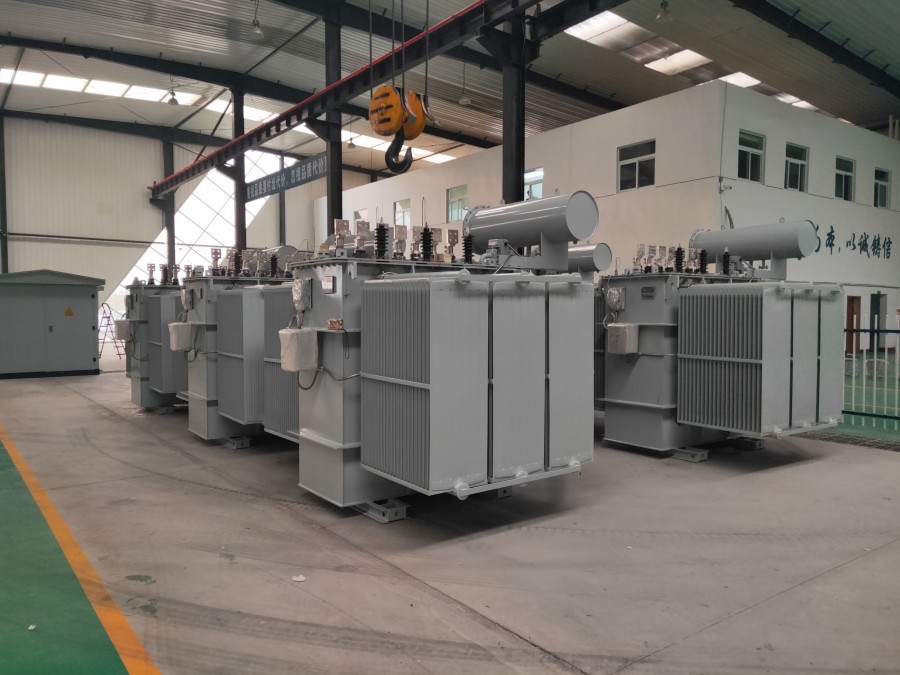
Because the design is simple, robust and highly efficient, the oil immersed distribution transformer remains the default choice for outdoor and semi-outdoor installations worldwide. Dry-type units are preferred inside buildings for fire-safety reasons, but for pole-mounted, pad-mounted and substation applications, oil-filled units still win on price, overload capacity and service life.
Two units with the same nameplate rating can differ enormously in real quality. What matters is what is inside the tank:
These model codes describe energy-efficiency generations of oil immersed distribution transformers, not different working principles. The number refers to the loss level: S11 is the classic design still widely used, S13 reduces no-load loss significantly by using better core steel, and S20 and S22 represent the modern high-efficiency generations with the lowest losses of the group. China's GB 20052 energy efficiency standard grades these units, and many utilities now reject anything below a certain grade for new installations.
The practical rule is simple. If your site runs lightly loaded or on intermittent duty, the cheaper S11 or S13 may be sufficient. If the transformer runs continuously at moderate to high load, the higher purchase price of an S20 or S22 unit is usually recovered within a few years through lower no-load loss. For renewable energy projects such as solar and wind farms, high-efficiency oil immersed units are almost always the right answer because the financial model depends on decades of low-loss operation.
Distribution networks, industrial plants, mining sites, commercial complexes, hospitals, water treatment plants, railway traction auxiliary supply, and renewable energy collection systems all rely on oil immersed distribution transformers. Mining duty and rectifier duty demand reinforced designs with higher short-circuit withstand and special winding configurations, while renewable energy projects typically require units optimised for low loss and wide-load-range efficiency.
The single biggest cost driver in a transformer purchase is not the steel or the copper, it is the number of hands the unit passes through. Distributors, trading companies and regional agents each add margin without adding technical value. Buying directly from the production line removes those layers and typically reduces landed cost by a meaningful margin, while also giving you direct access to engineers who can answer technical questions instead of forwarding them.
As an established transformer manufacturer, Runsheng Transformer Co., Ltd. produces oil-immersed units from 30 kVA to 6300 kVA across the S11, S13, S20 and S22 series, along with dry-type, amorphous alloy, mining, rectifier and custom special transformers. Every unit ships with a manual, inspection report, test certificate and lifelong quality tracking, so the saving comes from the supply chain, not from the specification.
Ask for the type test report, the routine test report for your specific unit, the winding material declaration, and a clear delivery and warranty commitment. Compare quotes on a like-for-like basis, meaning the same loss level, same winding material and same accessory list. A cheap quote with lower efficiency or thinner materials is not a saving, it is a deferred expense.
Get a factory-direct quotation and a technical proposal tailored to your capacity, voltage ratio and load profile:

Runsheng Transformer Co., Ltd. is a professional manufacturer of power transformers, specializing in oil-immersed transformers (S20, S11, S13), SH15 amorphous alloy transformers, S13 series 10KV 3D magnetic path wound-core transformers, D10 single-phase wound-core transformers, as well as mining transformers, rectifier transformers, surge arrestor transformers, load-tap-changing transformers, and custom-engineered special transformers.
WhatsApp & Wechat

No. 6, Intersection of Mount Huangshan Road and Changjiang Road, Liaocheng High tech Industrial Development Zone, Shandong, China


